Introduction
The need for a simple, fast, and yet sensitive diagnostic, screening, and molecular characterization tool is indispensable in clinical and research applications. There is a demand for a portable device which is user-friendly, low cost, rapid, and portable — one that provides a highly sensitive and specific assay in real-time. A portable surface plasmon resonance (SPR) instrument may be the answer.
Ever since Biacore commercialized its first SPR instrument in 1990, other manufacturers have entered the SPR instrumentation space. SPR instruments have mostly been sold to large pharmaceutical companies for drug discovery purposes. Many of these commercial instruments require trained personnel to operate and are not easily accessible, especially from a cost standpoint. As a result, we have seen in recent years more portable SPR instruments being introduced to the life science market. In this post, we discuss the differences and advantages of a portable SPR instrument over large, high-throughput commercial SPR systems.
Portable SPR vs. Large SPR System
Large commercial instruments are commonly used to obtain binding kinetics of drug candidates at a high-throughput screening (HTS) capacity. Although not designed for HTS, a portable SPR instrument has the advantage of being flexible — it can be reconfigured for multiple purposes such as bio- and chemical sensing, characterization of binding interactions, and assay development. One can use a portable SPR to perform any of these tasks in a rapid and straightforward manner.
Another advantageous feature of a portable SPR is its modularity. A portable SPR can be integrated with add-on accessories to simultaneously perform spectroscopy, electrochemistry, and chromatography. Where large systems lock researchers into a fixed workflow, a portable instrument adapts to the experiment rather than the other way around.
| Large SPR system | Portable SPR | |
|---|---|---|
| Accessibility | Accessible often only in centralized labs through advanced booking | Any benchtop or even off-site, anytime |
| Consumable cost | High | Low — sensor chips ranging from a few to tens of dollars per chip |
| Maintenance cost | High, yearly contract | Low to none |
| Type of operator | Trained personnel specifically for each SPR system | Any researcher, clinician, postdoc, or student |
| Applications | Binding kinetics of drug candidates | Bio-/chemosensing, characterization of binding interactions, assay development |
| Modularity | No | Yes |
The P4SPR™ from Affinité Instruments
Affinité Instruments developed the P4SPR to make SPR much more accessible to researchers in various types of biomolecular labs. To make the instrument robust, optical components are specially designed as fixed, non-moving parts. In particular, the P4SPR uses wavelength interrogation, which significantly drives down manufacturing and maintenance costs.
The P4SPR is very compact — roughly the size of a lunchbox — making it ideal for use in small lab spaces or in field settings. It features easy-accessible injection ports and a four-channel microfluidic cell that can accommodate up to four samples simultaneously. This design allows researchers to perform on-site, real-time testing without relying on the availability of centralized lab facilities.
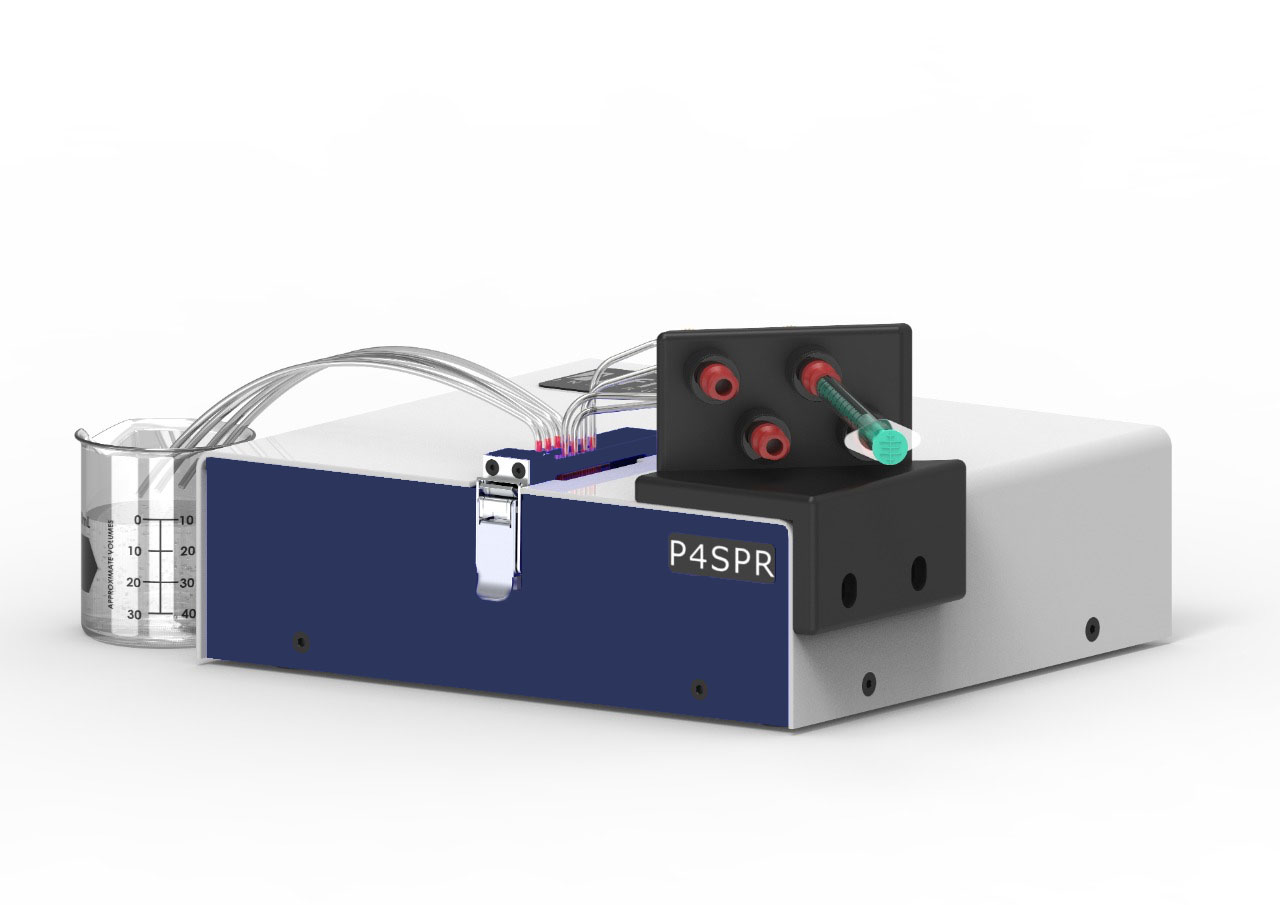
| Feature | Benefits |
|---|---|
| Compact, size of a lunchbox | Portability |
| Thin-film sensor | Highly sensitive to region ~200 nm from sensor surface. Well established area as opposed to localized SPR (LSPR) |
| Wavelength interrogation mode | Low equipment and maintenance costs, robust, and user-friendly |
| Label-free sample preparation | No need to buy purification kits and reagents. No effect on sample for kinetics and affinity. |
| Setup time to first analysis in less than 10 minutes | Simple setup |
| Real-time output | Fast results |
| Triplicate multichannel microfluidic cell with separate reference channel | Simultaneous acquisition of triplicate measurements. Reference corrects for any fluctuation in temperature and bulk refractive index changes. Long contact time for slow kinetics. |
| Direct injection with micropipette | Low sample volume |
| Integration with other techniques such as spectroscopy, microscopy, and electrochemistry | Flexibility in experimental setup and applications |
| Simplified software control with GUI | Real-time monitoring, data processing, and quantification |
Portability and Flexibility in Practice
The P4SPR has been used in pre-clinical research across a broad range of applications: detection of a breast cancer biomarker, small peptides, DNA, antibodies, explosives, and early-stage drug development screening. For instance, it helped elucidate the binding interactions between a transmembrane protein and small peptides by determining equilibrium dissociation constants from affinity curves.
A particularly compelling example of the P4SPR's portability advantage is the outdoor detection of explosive traces near a grenade range at a military base — in both summer and winter conditions. The need to prepare and transport samples to a centralized facility was eliminated entirely, allowing for continuous on-site, real-time monitoring over days and weeks. Total site setup time, including sensor calibration, sample preparation, and data gathering, was as little as one hour — far less than the days-long turnaround typical of centralized testing.
The breadth of applications for a portable SPR is wide — spanning three major areas:
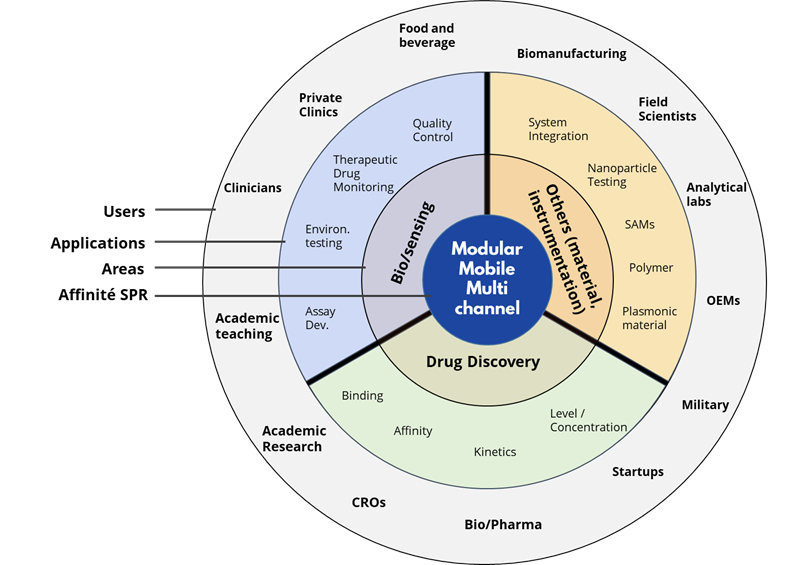
The common thread across all of these is that portability removes the logistical barriers that have traditionally kept SPR confined to large, well-equipped core facilities.
Conclusion
Portable SPR instruments like the P4SPR bridge the gap between high-performance binding analysis and practical, everyday lab use. By combining the sensitivity of optical biosensing with the accessibility of a compact, modular instrument, they open SPR to research contexts where large benchtop systems simply aren't an option. Whether in an academic lab, a field environment, or an early-stage biotech, the case for portable SPR continues to grow.
We help life science labs and biotech companies do rapid assay development and characterization. Feel free to reach out at info@affiniteinstruments.com.
References
- Julien Breault-Turcot and Jean-François Masson, "Nanostructured substrates for portable and miniature SPR biosensors," Anal. Bioanal. Chem., vol. 403, p. 1477, 2012.
- Arnoud Marquart, "SPRpages," 2006–2020.
- Affinité Instruments internal documentation.
- Carolina Gomez-Diaz et al., "A CD36 ectodomain mediates insect pheromone detection via a putative tunnelling mechanism," Nature Communications, vol. 7, p. 11866, 2016.
- Thibault Brulé et al., "A field-deployed surface plasmon resonance (SPR) sensor for RDX quantification in environmental waters," Analyst, vol. 142, p. 2161, 2017.