Technology
LSPR vs SPR: Pros and Cons
September 2026
Nanoparticle and thin-film plasmonic sensing compared: sensing depth, bulk sensitivity, optics, reproducibility, and which suits your assay.
Read →Application notes, research highlights, and practical guides from the team at Affinité Instruments.
September 2026
Nanoparticle and thin-film plasmonic sensing compared: sensing depth, bulk sensitivity, optics, reproducibility, and which suits your assay.
Read →September 2026
Why conventional SPR needs complex optics, and how lensless SPR keeps the Kretschmann configuration while streamlining everything around it.
Read →SPR on the Road · September 2026
First stop in our field series: we brought the portable P4SPR to Merck's New Jersey campus for real-time antibody characterization in biomanufacturing — and heard the same thing we heard at GSK. Everyone knows what they'd do with in-facility SPR data during a run.
Read →September 2026
Your binding questions, answered by a man with a doctorate and no patience for the price of a mass spectrometer. SPR talk, one question at a time.
Read →April 2026
Four recent studies trace the full arc from rational DNA probe design to a wearable device monitoring insulin in a living animal — with SPR at every step.
Read →November 2025
A new split-aptamer SPR biosensor enables real-time, label-free monitoring of vancomycin — a critical antibiotic where therapeutic drug monitoring can mean the difference between efficacy and toxicity.
Read →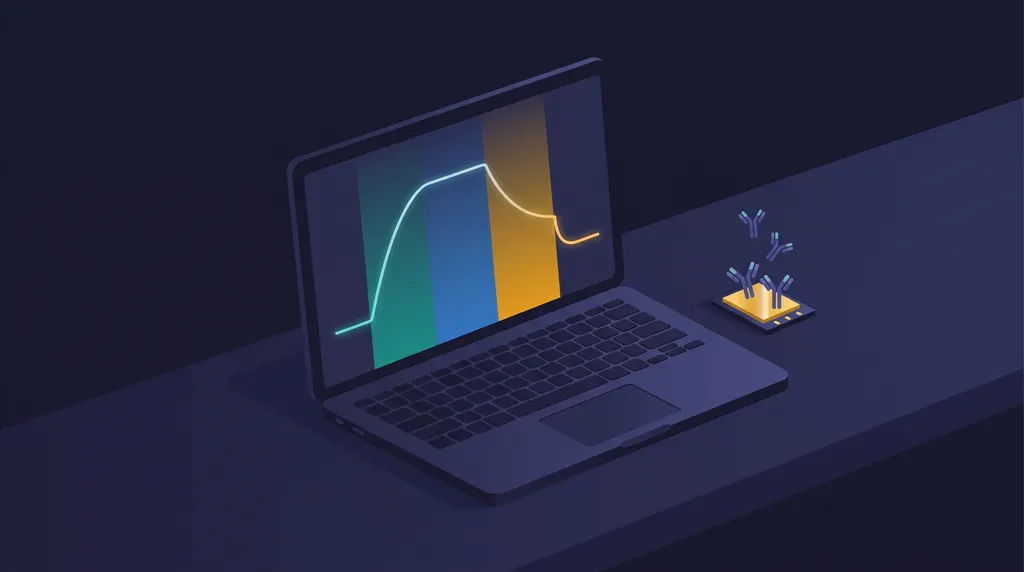
Updated September 2026
The sensorgram is the core output of every SPR experiment. Learn the five phases of a binding cycle and what kinetic and affinity data you can extract from each.
Read →November 2025
A quick-reference guide to the two core SPR measurement modes — when to use each, what data you get, and how to interpret the results.
Read →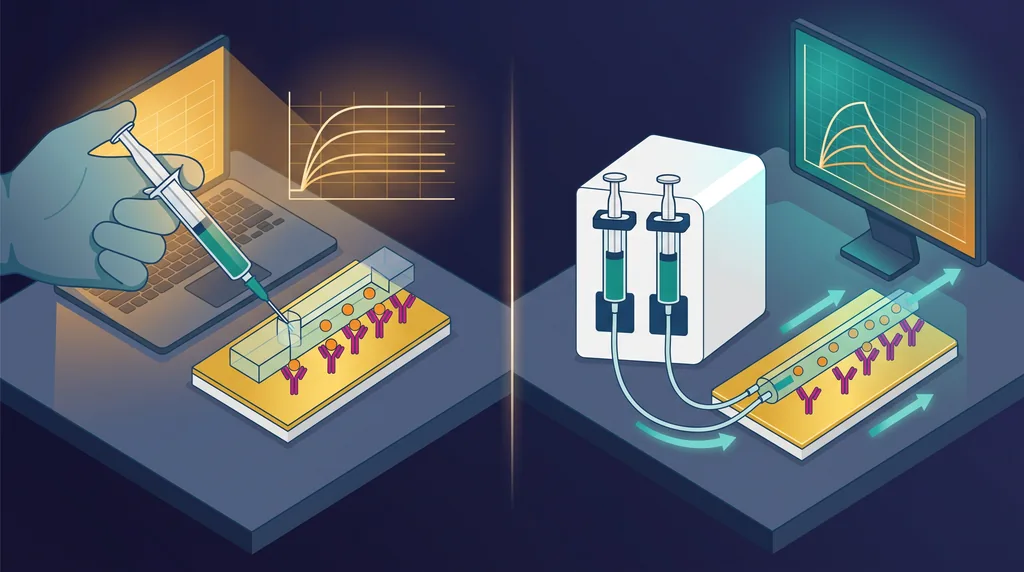
Updated September 2026
Steady-state or kinetic? The choice of injection mode determines what data you get. A clear breakdown of manual vs. pump-assisted SPR — when to use each and how to interpret the results.
Read →April 2024
Setting up an SPR experiment shouldn't require a surface chemistry PhD. Here's how Affinité sensors make the process straightforward from day one.
Read →June 2022
Calibration is the foundation of reliable SPR data. This guide walks through the calibration procedure using NaCl solutions and what to expect from a well-calibrated system.
Read →June 2022
AAV-based gene therapies require rigorous characterization at every production step. SPR provides real-time binding data that fits naturally into the bioproduction workflow.
Read →March 2022
Portability changes what's possible in the lab — and in the field. A look at what true portability means for SPR and why it matters for modern research workflows.
Read →September 2020
How portable SPR compares to large commercial systems — flexibility, modularity, on-site testing, and real-world applications from field detection to drug discovery.
Read →January 2022
Portable SPR proved its value in evaluating a novel vaccine platform — demonstrating that high-quality binding data doesn't require a fixed benchtop instrument.
Read →September 2020
Comparing binding performance across four antibody sources in under 2 hours — no ELISA required. A demonstration of portable SPR for fast biopharmaceutical QC.
Read →December 2021
Lateral flow assays are fast to deploy but slow to develop. SPR accelerates the critical early steps — antibody selection, affinity ranking, and surface optimization.
Read →
Updated September 2026
How to build a heparin surface, which controls to run, why salt didn't regenerate it, and how a competition assay showed which sulfates the spike protein needs.
Read →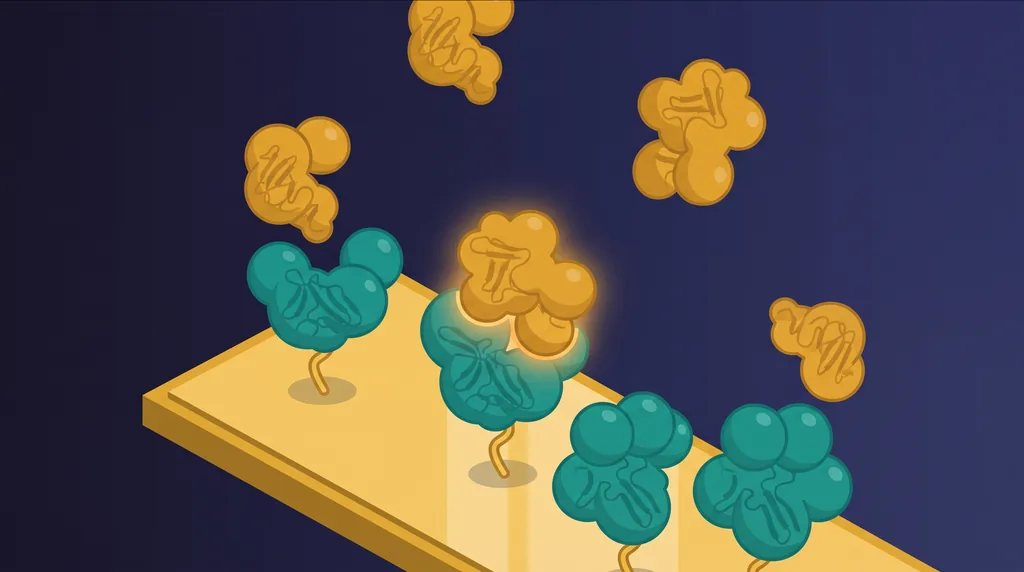
Updated September 2026
How tightly do two proteins bind, and how fast do they let go? Kinetic vs steady-state KD, assay design, and what bad data looks like.
Read →September 2021
Non-specific adsorption is one of the most common sources of unreliable SPR data. Afficoat — Affinité's proprietary surface chemistry — addresses this problem at the molecular level.
Read →
September 2021 · Updated September 2026
What SPR does well, where it falls short, and how to work around each limitation — plus when another technique is the better choice.
Read →July 2021
As SARS-CoV-2 variants emerged, SPR provided critical real-time data on how antibody cross-reactivity with native and variant spike proteins changes — with direct implications for vaccine strategy.
Read →June 2021
A novel SPR sensor surface based on ionic liquids enables detection of a breast cancer biomarker directly in cell lysates — demonstrating the power of surface chemistry innovation.
Read →May 2021
Synthetic biology depends on understanding how engineered molecules interact. SPR brings quantitative binding data to the design-build-test cycle.
Read →May 2021
Environmental contaminant testing traditionally requires samples to be sent to a lab. Portable SPR changes that — bringing real-time detection to the field.
Read →March 2021
A direct comparison of SPR and bio-layer interferometry (BLI) for prostate-specific antigen detection in human serum — with implications for which technology best suits clinical biosensing.
Read →December 2020
Liposomes are central to drug delivery and membrane biology research. SPR provides a powerful label-free method for characterizing liposome binding and membrane interactions.
Read →
November 2020 · Updated September 2026
Label-free and real-time vs endpoint and enzyme-amplified: how SPR and ELISA differ, what each measures, and when ELISA is still the better choice.
Read →No posts found in this category.