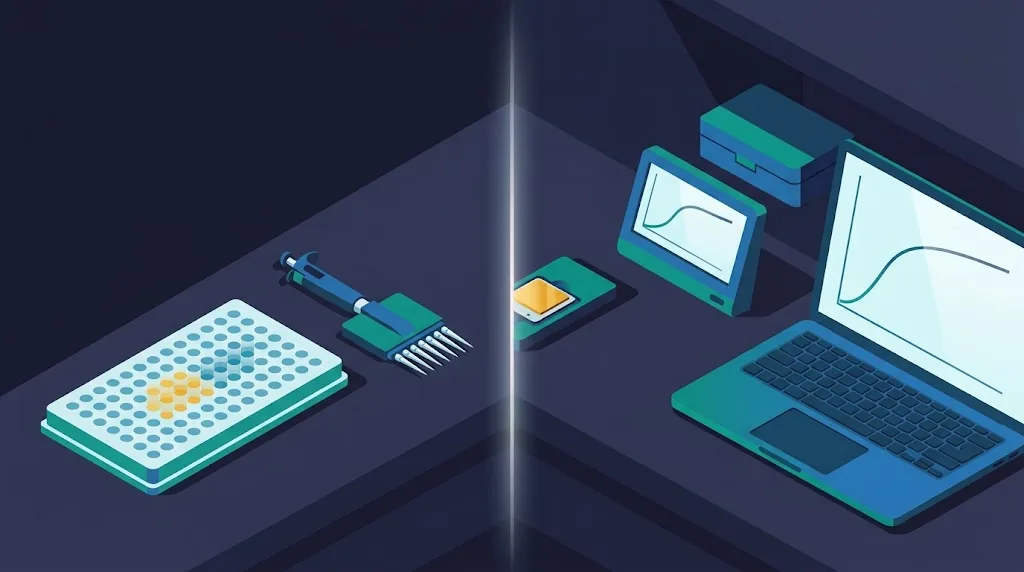
ELISA has been the gold standard for detecting and quantifying biomolecules for 50 years. Surface plasmon resonance (SPR) answers some of the same questions in a different way. Here is how the two compare, where SPR outperforms ELISA (real-time kinetics, label-free detection and sensitivity to low-affinity interactions), and when ELISA is still the better choice.
What is the difference between SPR and ELISA?
SPR (surface plasmon resonance) is a label-free optical technique that follows binding in real time as molecules attach to a sensor surface, giving affinity and, in flow mode, kinetics (ka, kd). ELISA (enzyme-linked immunosorbent assay) is an endpoint plate assay that detects binding through an enzyme-linked antibody after incubation and washing, giving a yes/no answer or a concentration.
SPR vs ELISA at a glance
| Criterion | SPR | ELISA |
|---|---|---|
| Labels | Label-free: binding is detected as a refractive-index change at the sensor surface | Needs an enzyme-linked detection antibody and a substrate to generate a colorimetric, fluorescent or luminescent signal |
| Readout | Real time: the whole binding event is recorded as a sensorgram | Endpoint: a single reading after the signal-generation step |
| Kinetics | Yes: association and dissociation rate constants (ka, kd) in flow mode | No kinetic information |
| Affinity | KD from kinetics (kd/ka) or from steady-state responses across a concentration series | Apparent affinity only, typically as an EC50 from a titration |
| Washing steps and weak binders | Binding is read while analyte is in contact with the sensor, so weak, fast-dissociating binders are still recorded | Repeated washes before the readout can remove weakly bound molecules, so low-affinity binders can be missed |
| Sensitivity | Most sensitive to low-affinity interactions that washing would remove; the signal depends on the mass bound at the surface | Enzymatic amplification gives high sensitivity and specificity, especially for high-affinity binders |
| Throughput and format | Channel-based: a few channels per run (4 on Affinité instruments); sensors can be regenerated and reused | Plate-based: many wells of a 96-well (or larger) plate processed in parallel |
| Time to result | Minutes to hours | Hours to days |
| Familiarity and setup | Needs an SPR instrument and a surface chemistry to immobilize the ligand | Standard in most labs; runs on a common plate reader, with established kits for many targets |
What is ELISA?
ELISA (enzyme-linked immunosorbent assay) is a plate-based immunoassay for detecting and quantifying antibodies, peptides, proteins and other biomolecules. The target is captured in a well, and an enzyme-linked antibody converts a substrate into a measurable signal. Direct, indirect and sandwich ELISA all rely on this secondary, signal-generating reaction.
ELISA has been the gold standard for the quantification and detection of antibodies, peptides, proteins, and other biomolecules for the past 50 years. The main advantages of ELISA are high sensitivity and specificity. However, a sandwich ELISA has notable disadvantages: it is laborious, time-consuming, requires labeled detection antibodies and several reagent steps, and provides only endpoint data with no kinetic information.
How does SPR detect binding without labels?
SPR detects binding through a change in refractive index at a thin gold sensor surface. A ligand is immobilized on the sensor, and as analyte binds to it, the resonance condition of the reflected light shifts. No enzyme, fluorophore or secondary antibody is needed, and the signal is recorded continuously as a sensorgram.
SPR is an optical, label-free technique because there is no requirement for a label. Detection is achieved by a change in refractive index at the sensing interface. In an SPR experiment, a plane-polarized, monochromatic incident light shines upon a material of high refractive index in total internal reflection conditions. If there is a change in refractive index due to analytes binding to surface-immobilized receptors, the SPR response signal changes.
SPR can be collected in real-time to determine both kinetics and affinity information. ELISA, on the other hand, is an endpoint detection method which can only provide apparent affinity data (for example an EC50). The manual injection mode in SPR leads to affinity data by determining the equilibrium dissociation constant (KD) from the sensorgrams. The pump-assisted mode yields both affinity and kinetic data by determining the rates of association and dissociation. See how to read an SPR sensorgram.
Is SPR faster than ELISA?
Usually, yes. SPR detects binding directly through a change in refractive index, so it bypasses the secondary antibody and signal-generation steps of an ELISA. Results can typically be obtained by SPR in minutes to hours, compared with hours to days for ELISA, because there are fewer incubation, blocking and manual washing steps.
In the ELISA protocol, washing, incubation, blocking, and signal generation steps all require extra time and manual steps. In SPR, washing and other sensor preparation steps can be done quickly inside the SPR instrument itself. In one antibody quality-control study, an SPR comparison of antibody lots took about 2 hours.
Why can SPR detect low-affinity antibodies that ELISA misses?
SPR reads binding while the analyte is still in contact with the sensor, so weakly bound, fast-dissociating molecules are recorded before they leave. In ELISA, repeated washing steps before the readout can strip these low-affinity binders from the plate. In a clinical comparison, SPR identified more patients with low-affinity anti-drug antibodies than ELISA did.
Sometimes low-affinity interactions are more relevant than high-affinity ones for a particular application. One example relates to patient safety. An article by Nechansky reviews the studies that compared ELISA and SPR for the detection of human anti-human antibody (HAHA) response towards therapeutic monoclonal antibodies (mAbs). One result of HAHA may be induced autoimmunity, whose side effects can be severe life-threatening conditions.
In one study by Lofgren et al., the researchers found that SPR identified 4.1% positive patients vs. 0.3% by ELISA. The highest affinity antibodies were detected with a higher sensitivity with ELISA, while SPR detected the low affinity antibodies with a higher sensitivity. This was likely due to the fact that low affinity antibodies were lost during repeated washing steps in ELISA, whereas SPR was able to collect data in real-time even for weak (high KD) interactions.
The low affinity antibodies are indicators of early onset autoimmunity and can evolve into higher affinity antibodies by a process called affinity maturation. To ensure patient safety, SPR should be used as a more sensitive method to detect low affinity antibodies, allowing patients to be better monitored by physicians even if they do not display any clinical symptoms.
When is ELISA the better choice?
When the question is simply whether something binds, or how much is there, ELISA is often the right tool. It runs on a standard plate reader, handles many samples in parallel, has established kits for many targets, and most labs already run it. Choose SPR when you need to know how it binds: how fast and for how long.
- You need a yes/no binding answer or a concentration, and kinetics would not change your decision
- You are screening many samples at once in plate format
- An established ELISA already exists for your target and sample type
- Your analytes are high-affinity binders, where ELISA's enzymatic amplification gives high sensitivity
- Your team runs ELISA routinely and has no SPR access yet
Just know what you are trading away. As Dr. Live puts it on our Ask Dr. Live page, ELISA is a smoke alarm: it tells you that something happened, not how fast it happened or whether it stuck around. A binder that snaps on and falls straight back off and one that arrives slowly and stays can give an identical score on the plate. If your real question is whether your binder is any good, that is a kinetics question, and SPR is built to answer it.
When should you choose SPR over ELISA?
Choose SPR when you need more than a yes/no answer: association and dissociation rates, an equilibrium KD, detection of weak or transient binders that washing would remove, or real-time, label-free monitoring. SPR also suits assay development, where you want to watch immobilization and binding happen rather than infer them from an endpoint signal.
For examples, see how SPR was used for antibody quality control and to optimize an immunosensing assay in undiluted human serum.
Which Affinité SPR instrument fits an ELISA-style workflow?
The P4SPR 2.0 is a static-mode SPR instrument: samples are injected by syringe and bind by diffusion, giving affinity (KD) and concentration data without labels, much like a label-free ELISA. The P4PRO with AffiPump runs both static and flow-based experiments on one instrument, adding full kinetics (ka, kd, KD).
Affinité's P4SPR is an excellent SPR instrument that can provide high quality, real-time data to suit your research needs. It requires no labels or secondary reactions and reduces a significant amount of precious research time compared to performing an ELISA assay. It can also detect low affinity interactions with a higher sensitivity than ELISA due to real-time monitoring. Compare the modes in our static vs kinetic SPR technical note, or compare the instruments.
Comparing SPR with other label-free methods such as BLI or ITC? Use our technique comparison tool.
SPR vs ELISA: frequently asked questions
What is the difference between SPR and ELISA?
SPR (surface plasmon resonance) is a label-free optical technique that follows binding in real time as molecules attach to a sensor surface, giving affinity and, in flow mode, kinetics (ka, kd). ELISA (enzyme-linked immunosorbent assay) is an endpoint plate assay that detects binding through an enzyme-linked antibody after incubation and washing, giving a yes/no answer or a concentration.
Can ELISA measure binding kinetics?
No. ELISA is an endpoint assay: it reports a single signal after incubation, washing and signal generation, so it cannot resolve association or dissociation rates. It can estimate an apparent affinity, typically as an EC50 from a titration. SPR records binding continuously and, in flow mode, measures the association and dissociation rate constants (ka, kd) as well as KD.
Is SPR more sensitive than ELISA?
It depends on the interaction. ELISA's enzymatic signal amplification gives high sensitivity for high-affinity binders. SPR is more sensitive to low-affinity, fast-dissociating binders, because it reads binding in real time instead of after washing steps. In one clinical comparison of anti-drug antibody detection, SPR identified 4.1% of patients as positive versus 0.3% by ELISA.
When is ELISA a better choice than SPR?
When the question is simply whether something binds, or how much is there, ELISA is often the right tool. It runs on a standard plate reader, handles many samples in parallel, has established kits for many targets, and most labs already run it. Choose SPR when you need to know how it binds: how fast and for how long.