Introduction
Acute lymphoblastic leukemia (ALL) is a disease where immature white blood cells originating from the bone marrow become cancerous, inducing proliferation in the blood flow and subsequently to organs, while preventing the proper function of other blood cells. One of the main chemotherapeutic agents proven efficacious for ALL is E. coli L-asparaginase (EcAII), a biological therapeutic agent.1 A significant clinical challenge is that patients can develop silent inactivation of the drug by generating neutralizing antibodies against EcAII, thereby reducing treatment efficiency.2
To detect the presence of anti-EcAII in patients, EcAII is employed in an immunoassay format. This method was previously used with the P4SPR to detect the anti-therapeutic antibody in undiluted serum of pediatric patients.3 Biosensing with SPR minimizes sample preparation and reduces analysis time. However, the main challenge of developing the assay was to immobilize native EcAII antigen with reproducible sensor efficiency.
SPR is a powerful bioanalytical technique for assay optimization — it provides real-time, label-free monitoring of binding interactions. In this work, the immobilization density and the level of response to the anti-EcAII antibody were carefully monitored to understand the mechanism of the immobilization process and determine the optimal protocol for building a clinically relevant immunosensor.
Immobilization Challenges of Native EcAII
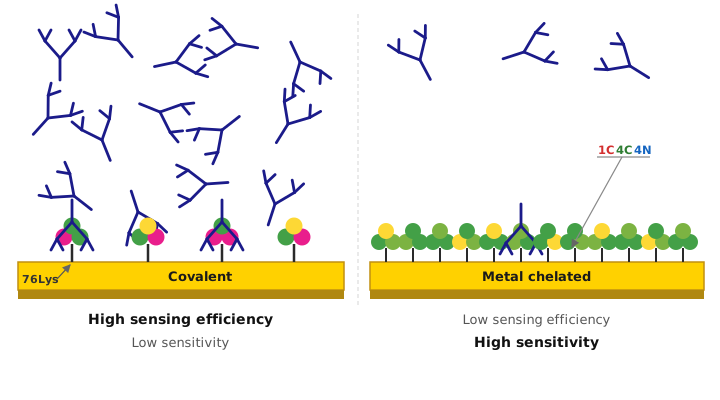
In SPR assay development, the immobilization approach plays a crucial role in ensuring optimal and reproducible sensing efficiency. The immobilization chemistry may affect the efficacy of antibody recognition if the immobilized receptors have obstructed binding sites (Figure 1). This poses a challenge for SPR sensing — and any immunoassay — where sensitivity depends on optimal protein–protein binding interactions.
An additional key challenge is maintaining the quaternary structure upon immobilization. EcAII forms a functional homotetramer through the dimerization of intimate homodimers, exhibiting four identical active sites. Alterations to this quaternary structure could affect the SPR signal and produce misleading data. Both protein density on the surface and structural integrity are critical factors in building an effective EcAII immunosensor.
Although several antigenic determinants of EcAII have been identified, its antigenicity in an immobilized form remained unknown. To better understand these contributions to patient immunogenicity, a heterogeneous (random, covalent) surface immobilization of native EcAII was compared to a homogeneous (oriented, His-tag) one.
Experimental Design
1EcAII Variants Tested
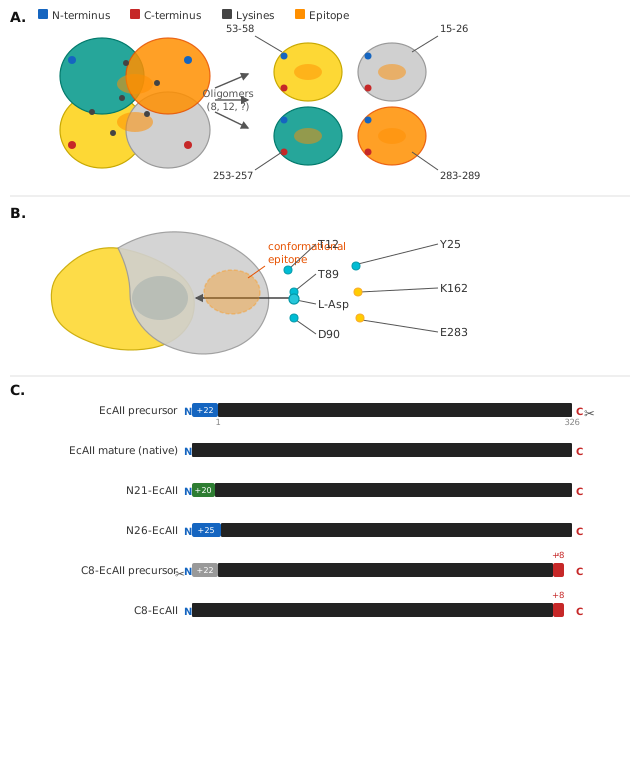
Three His-tagged versions of EcAII were designed and produced in-house for immobilization and SPR sensing:
- N21-EcAII — N-terminal His-tag with 20 additional amino acids
- N26-EcAII — N-terminal His-tag with 25 additional amino acids
- C8-EcAII — C-terminal His-tag with 8 additional amino acids (tetrameric and monomeric forms)
Native EcAII (Kidrolase, EUSA Pharma) served as the reference for covalent immobilization.
2Surface Preparation
Covalent (Random) — Native EcAII
- AffiCoat peptide SAM deposited on gold sensor
- Terminal –COOH activated with EDC/NHS
- Native EcAII binds via lysine residues (random orientation)
- 20 min contact, then buffer wash
Metal Chelation (Oriented) — His-tagged EcAII
- AffiCoat peptide SAM deposited on gold sensor
- Co-NTA further attached onto AffiCoat
- His-tagged EcAII coordinates via terminal histidines (oriented)
- 20 min contact, then buffer wash
3Immunosensing Protocol
SPR experiments were performed using the benchtop P4SPR. After surface preparation, the immunosensor was passivated to reduce nonspecific binding. The assay sequence was:
(10 min)
- Blank human serum injection
(20 min)
- 15 µg mL⁻¹ anti-EcAII serum
- Monitor binding
(20 min)
- 150 µg mL⁻¹ anti-EcAII serum
- Monitor binding
Results: Immobilization Characterization
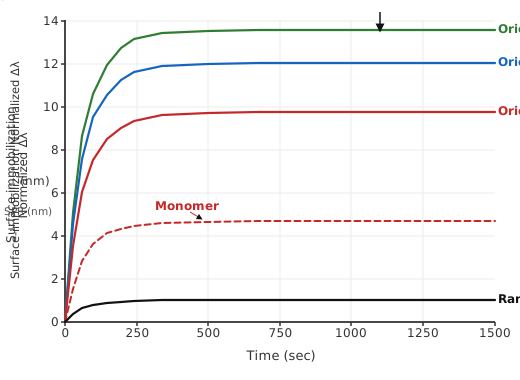
The surface coverage determined for oriented His-tagged EcAII was 5 to over 10-fold greater than covalent cross-linked native EcAII (Table 1). His-tagged EcAII was also far more reproducible, with relative standard deviation (RSD) of 3–18%, compared to 50–70% for native EcAII.
The lower surface coverage of C8-EcAII relative to N-terminal variants is explained by the reduced accessibility of the 8-residue C-terminal tag for metal coordination. Notably, results showed that monomeric C8-EcAII did not re-assemble into a tetrameric form upon immobilization, whereas all tetrameric EcAII variants retained their quaternary structure — confirmed by the corresponding immunosensor SPR response.
| Receptor (Ag) immobilization | Antibody (Ab) detection | |||||
|---|---|---|---|---|---|---|
| Protein | ΔλSPR (nm) | Surface density (pmol cm⁻²) | Activity (U mg⁻¹) | Distance c.t.c. (nm) | ΔλSPR (nm) | Sensing efficiency (Ab/Ag ratio) |
| Kidrolase (native) | 1 ± 0.7 | 0.3 ± 0.2 | 310 ± 260 | 30.5 | 2.5 ± 0.9 | 2.3 ± 0.8 |
| N21-EcAII | 13.5 ± 0.6 | 3.3 ± 0.2 | 87 ± 7 | 8.5 | 12.2 ± 1.3 | 0.9 ± 0.1 |
| N26-EcAII | 12 ± 2 | 2.9 ± 0.5 | 95 ± 10 | 9.1 | 11.3 ± 0.8 | 0.9 ± 0.1 |
| C8-EcAII (tetrameric) | 9.7 ± 0.8 | 2.5 ± 0.2 | 160 ± 87 | 9.9 | 8.3 ± 0.7 | 0.9 ± 0.03 |
| C8-EcAII (monomeric) | 4.6 ± 0.8 | 4.7 ± 0.8c | 0 | 14.4 | 3.2 ± 0.5 | 0.2 ± 0.03c |
| EcAIIcrystald (tetramer) | — | 1.9 | — | 11.4 | — | — |
| EcAIIcrystale (monomer) | — | 2.1 | — | 10.8 | — | — |
| Detection using 150 µg mL⁻¹ anti-EcAII antibody. c Density or binding ratio of the monomer; values comparable to 4 monomers (1 equiv. tetramer) in parentheses. d Unit cell dimensions for EcAII in tetrameric form (PDB 3ECA). e Unit cell dimensions for EcAII in monomeric form (PDB 1NNS). | ||||||
Table 1. Summary of immobilization and immunosensing performance of EcAII receptors.
Results: Sensing Efficiency
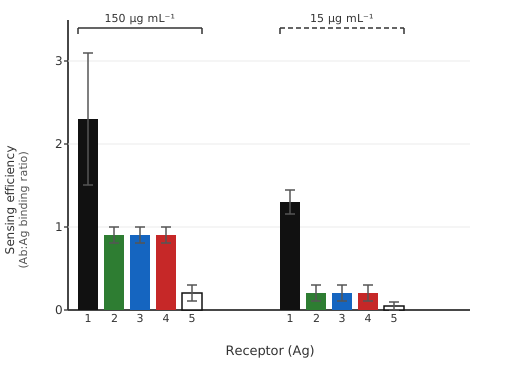
Sensing efficiency — defined as the Ab/Ag binding ratio — revealed an interesting trade-off. Native tetrameric EcAII (Kidrolase) showed a significantly better sensing efficiency than the His-tagged variants despite its lower surface density and poorer reproducibility. An average of 2.3 anti-EcAII antibodies were detected per immobilized Kidrolase molecule, approximately 2-fold higher than the 0.9 Ab/Ag binding ratio for tetrameric His-tagged EcAII variants.
This is explained by the density differential. The average surface density of immobilized Kidrolase was ~7-fold lower than the crystallographic native EcAII density (1.6 × 10¹¹ vs ~1.15 × 10¹² molecules cm−2), giving center-to-center (c.t.c.) distances of 30.5 nm vs 11.4 nm between protein tetramers. In contrast, oriented His-tagged EcAII variants were packed 1.3 to 1.8-fold more densely than in the crystal lattice, with c.t.c. distances of ~8.5–9.9 nm — potentially favoring bivalent antibody binding and reducing the per-molecule binding ratio.
Despite lower per-molecule efficiency, the greater surface density and reproducibility of His-tagged EcAII variants ultimately ensure superior overall sensitivity. RSD of immunosensing signals was 5–20% for His-tagged variants vs 35% for native Kidrolase. A strong correlation was observed between immunosensing signal and surface coverage (R² = 0.9571 at 150 µg mL⁻¹).
The P4SPR Advantage
Modular & Portable
Compact, benchtop design with flexible assay development capabilities — ideal for systematic optimization of immobilization parameters.
Multichannel Precision
Four simultaneous channels enable triplicate sample measurements with built-in reference subtraction, improving result precision and reproducibility.
No Sample Pre-treatment
Direct measurement in undiluted human serum — no purification, radiolabeling, or complex pre-processing required.
Real-time Label-free Monitoring
Continuous monitoring of both the immobilization phase and the antibody-binding phase in a single experiment, accelerating assay development cycles.
P4SPR vs ELISA
- Label-free — no secondary antibodies or enzymatic reporters
- Minimal reagents used
- Fewer preparation steps
- Reduced time and reagent costs
- Real-time kinetic data, not endpoint measurement
Conclusion
This study demonstrated how the P4SPR enables systematic optimization of SPR immunosensor design by providing real-time, quantitative data on both immobilization density and antibody-binding efficiency. Oriented immobilization via terminal His-tags produced 5–10× greater surface coverage with markedly better reproducibility (RSD 3–18%) than random covalent cross-linking (RSD 50–70%). Although sensing efficiency (Ab/Ag ratio) was lower for oriented variants due to higher packing density, the overall immunosensing signal was up to 5-fold greater, validating oriented immobilization as the preferred strategy for clinical immunosensing applications.
These findings establish a clear protocol for developing robust EcAII immunosensors for monitoring anti-asparaginase antibody levels in leukemia patients — an application where sensitivity and reproducibility in complex biological matrices are critical.
Annex: Surface Coverage Calculation
The surface coverage (Γ, ng cm−2) of immobilized native or His-tagged EcAII was calculated from the SPR wavelength shift (ΔλSPR) using:
Where:
- ρ = density of adsorbed protein monolayer (1.3 g cm−3)
- ld = plasmon penetration distance (~230 nm)
- Δλ = SPR wavelength shift associated with protein immobilization
- m = refractive index sensitivity of the SPR sensor (1765 nm/RIU)
- nSAM = refractive index of the peptide SAM (1.57 RIU)
- nmedium = refractive index of buffer (1.33476 RIU)
The total amount of immobilized EcAII on the sensing surface (Q) was determined using Q = ΓS, where S = 0.166 cm2 in contact with the protein.
2 Shinnick, S. E.; Browning, M. L.; Koontz, S. E. Managing hypersensitivity to asparaginase in pediatrics, adolescents, and young adults. J. Pediatr. Oncol. Nurs. 2013, 30, 63–77.
3 Aubé, A.; Charbonneau, D. M.; Pelletier, J. N.; Masson, J.-F. Response monitoring of acute lymphoblastic leukemia patients undergoing L-asparaginase therapy: Successes and challenges associated with clinical sample analysis in plasmonic sensing. ACS Sens. 2016, 1, 1358–1365. doi: 10.1021/acssensors.6b00371
4 Epp, O.; Steigemann, W.; Formanek, H.; Huber, R. Crystallographic evidence for the tetrameric subunit structure of L-asparaginase from Escherichia coli. Eur. J. Biochem. 1971, 20, 432–437.