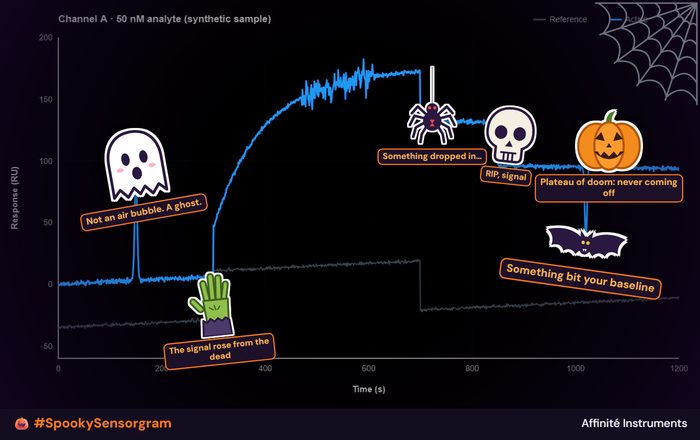
Subject: the signal never comes back down. is my surface haunted?Posted: 2026-09-27
stuck_at_plateauNew MemberPosts: 1
From: the forum
“After the injection the curve drops a little and then just… stays up. Every cycle starts higher than the last one. Is my analyte glued on forever?”
Re: the signal never comes back down. is my surface haunted?
Dr. Live✳ Moderator ✳Posts: 4,412
Joined: Day One
From: the bench
Two usual suspects, and only one of them is a problem. Suspect one: the binding really is that tight. Some complexes barely let go in a few minutes. That's real data. A flat dissociation means record longer, not panic. Suspect two, and it's the one I'd bet on because every cycle starts higher: your regeneration isn't clearing the surface. Leftover analyte piles up, the baseline climbs, and your binding capacity quietly shrinks. Test it: after regeneration, does the baseline come back to where the cycle started? If not, scout a slightly stronger regeneration in short pulses (lower pH, a little salt or detergent), and check your ligand still binds afterwards. The ghost in your sensorgram is usually just last cycle's analyte that nobody asked to leave.
-- Dr. Live is the name, SPR is the game --
Subject: I packed the chip with ligand. Why did my kinetics get worse?Posted: 2026-09-27
more_is_more_ligandNew MemberPosts: 1
From: the forum
“More ligand should mean more signal, right? I cranked up the immobilization, got a huge response, and now my association looks like a straight line, the dissociation barely moves, and the 1:1 fit is garbage. Did I break it by trying too hard?”
Re: I packed the chip with ligand. Why did my kinetics get worse?
Dr. Live✳ Moderator ✳Posts: 4,412
Joined: Day One
From: the bench
You didn't break it. You overcrowded it. A packed surface does three things you never asked for. One: it grabs analyte faster than the flow can deliver it, so you're measuring delivery, not binding. That's your straight-line association. Two: anything that lets go lands on the next ligand over before it can escape, so dissociation looks slower than it really is. Three: if your analyte has two arms, a crowded surface lets it hold two ligands at once, and your "affinity" quietly becomes avidity. For kinetics, immobilize just enough to see a clean signal. Work backwards from the maximum response you want: Rmax = (analyte MW ÷ ligand MW) × ligand response × binding sites per ligand. Then aim low. Save the packed surface for concentration measurements, where more signal genuinely helps. Less ligand, better numbers. It feels wrong. It isn't.
-- Dr. Live is the name, SPR is the game --
Subject: My antibody refuses to dissociate and the 1:1 fit is garbagePosted: 2026-09-18
AvidAnnieNew MemberPosts: 1
From: the forum
“Dr. Live,
I am measuring a monoclonal antibody binding its antigen and the dissociation phase is basically flat -- the signal barely comes down over ten minutes. When I try to fit a 1:1 model the residuals are all over the place and the koff is absurdly small. The antigen is immobilized on the chip and I am flowing the antibody as the analyte. Is my antibody just really high affinity, or is something off?”
Re: My antibody refuses to dissociate and the 1:1 fit is garbage
Dr. Live✳ Moderator ✳Posts: 4,412
Joined: Day One
From: the bench
Your antibody is not that good. Nobody's is. You immobilized the antigen and are flowing a bivalent IgG over it, which means each antibody can grab two antigens at once. Once both arms are down, it is not letting go -- not because the affinity is picomolar, but because avidity is cheating. That flat dissociation and that garbage 1:1 fit are the textbook signature of a bivalent analyte pretending to be monovalent.
What to do. First: flip the orientation. Capture the antibody on the surface (anti-Fc, or Protein A/G) and flow the antigen as the analyte. Monovalent interaction, one arm, honest kinetics. This is the single most important fix. Second: if you cannot flip it, use a monovalent analyte -- a Fab fragment -- and watch that impossible off-rate suddenly become measurable. Third: if you genuinely care about the avidity because that is how the thing behaves in vivo, then fit a bivalent-analyte model and report it as avidity, not affinity. Just do not call a two-armed number a KD.
High affinity is a lovely fantasy. Orientation is the truth.
-- Dr. Live is the name, SPR is the game --
Subject: Association phase looks like a ramp, not a curvePosted: 2026-09-18
SkiSlopeSamNew MemberPosts: 1
From: the forum
“Hi Dr. Live,
My association phase looks almost completely linear -- it ramps up in a straight line instead of curving toward a plateau, and my fitted kon comes out way lower than the literature value for this pair. Dissociation looks weirdly slow too. I am running a 25 kDa analyte over a fairly high-density surface. Am I doing something wrong in the fit, or is this a real kinetic effect?”
Re: Association phase looks like a ramp, not a curve
Dr. Live✳ Moderator ✳Posts: 4,412
Joined: Day One
From: the bench
That straight-line association is not kinetics. It is a traffic jam. You have loaded so much ligand onto that chip that every analyte molecule reaching the surface gets grabbed the instant it arrives, and now the rate you are measuring is not how fast they bind -- it is how fast they can diffuse down to the surface. That is mass transport limitation, and it lies to you in both directions: kon looks too slow, koff looks too slow, and your KD is fiction.
Fix it, in order. First: drop your ligand density. Aim for an Rmax of 30-50 RU, not 500. Less ligand, less traffic. Second: crank the flow rate. 30 uL/min is where people get lazy -- go to 50-100 and give the analyte less time to run out of road. Third: if you insist on keeping a busy surface, fit with a mass-transport term instead of pretending it is clean 1:1 -- but that is a bandage, not a cure. Lower the density first. Always.
A linear association is the single most common self-inflicted wound in SPR. Now you know what it looks like.
-- Dr. Live is the name, SPR is the game --
Subject: Difficult antigenPosted: 2026-09-10
SPRbeginsNew MemberPosts: 1
From: the forum
“Hi Dr.Live,
What would you recommend for surface chemistry for a difficult antigen: 90 kDa, small purified amounts (10ug/L max), crashes out after 3 hours at room temp, antibody binding appears to stabilize it. I suppose we're looking for something that can maximize capture on the chip. It also appears better behaved in crude lysate. Can we do proper kinetics using crude?”
Re: Difficult antigen
Dr. Live✳ Moderator ✳Posts: 4,412
Joined: Day One
From: the bench
Ninety kDa, ten micrograms, crashes out after three hours and behaves better in crud. You do not have a difficult antigen. You have a diva. First: forget covalent coupling. You do not have the material to waste on amine coupling optimization at those concentrations, and your protein will be face-down in the EDC before you finish the activation. Capture it. Anti-tag if it has one, anti-His on NTA if it is His-tagged, or go antibody-capture since you already know the antibody stabilizes it. That buys you orientation AND stability in one move. Second: yes, you can do kinetics from crude lysate, but only if your capture surface is specific enough that the crud does not stick. Run a blank lysate injection first. If the reference channel stays flat, you are golden. If it drifts, you need a higher-density capture antibody or a better block. Third: keep everything at 4C until the moment of injection. If it crashes at three hours room temp, do not give it three hours. Prep on ice, inject fast, regenerate, repeat.
-- Dr. Live is the name, SPR is the game --
Subject: Regeneration buffer keeps killing my ligandPosted: 2026-09-10
KineticKatNew MemberPosts: 1
From: the forum
“I am using 10 mM glycine pH 2.0 for regeneration but after 5-6 cycles my ligand activity drops to almost nothing. The sensorgrams look fine at first but the Rmax keeps falling. Is my regeneration too harsh or is something else going on? Should I try a milder buffer or shorter contact time?”
Re: Regeneration buffer keeps killing my ligand
Dr. Live✳ Moderator ✳Posts: 4,412
Joined: Day One
From: the bench
Glycine pH 2.0 is not regeneration. It is assault. Your ligand is not falling off the surface because it got bored. You are denaturing it, cycle by cycle, and then acting surprised when a dead protein stops catching things. Try pH 2.5 first. If that works, you just bought yourself fifty more cycles. If it does not, switch to 10 mM NaOH for 30 seconds -- shorter contact, less carnage. The Rmax dropping is your ligand waving goodbye. Stop ignoring it.
-- Dr. Live is the name, SPR is the game --
Subject: Bulk refractive index jump masking my binding signalPosted: 2026-09-10
BufferBuddyNew MemberPosts: 1
From: the forum
“I am running a small molecule analyte (about 350 Da) and the buffer jump when I inject is so large that I can barely see any binding response underneath. I am already using reference subtraction but the curves still look noisy. Any tips on reducing the bulk effect or is there a better way to handle this in the analysis?”
Re: Bulk refractive index jump masking my binding signal
Dr. Live✳ Moderator ✳Posts: 4,412
Joined: Day One
From: the bench
350 Da. You poor thing. At that weight your analyte is whispering and the bulk jump is screaming. Reference subtraction is necessary but not sufficient -- if your running buffer and sample buffer are not identical down to the DMSO percentage, the subtraction is subtracting the wrong thing. Match your buffers. Exactly. Then run a solvent correction series if you have not already. That alone will clean up half your noise. The other half is probably your flow rate being too low -- crank it up, shorten the contact time, and let the kinetics do the talking.
-- Dr. Live is the name, SPR is the game --