The basics
What is SPR regeneration?
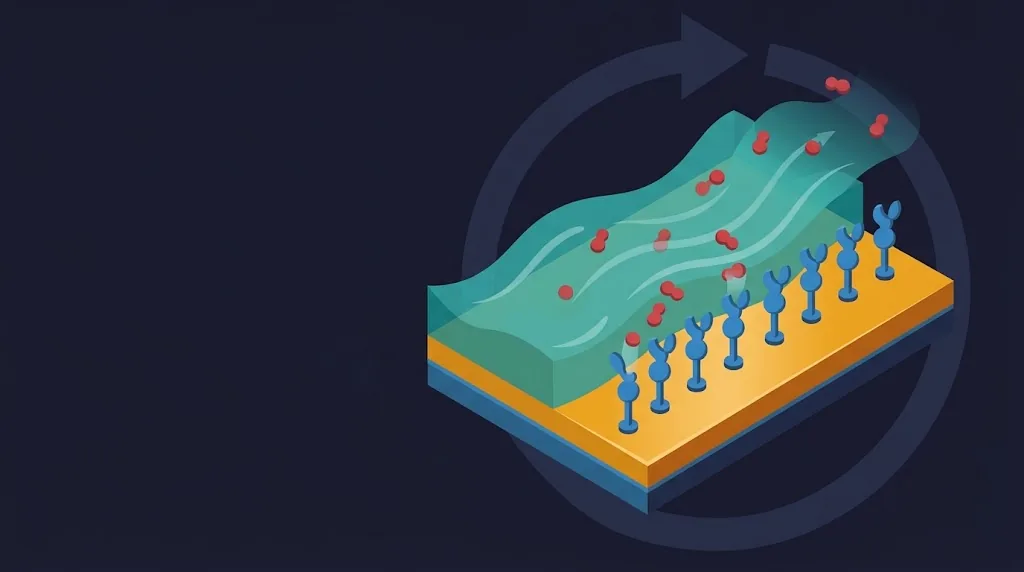
Regeneration is a short injection of a solution that removes bound analyte from the sensor surface between binding cycles, returning the signal to baseline so the same ligand can be used again. It has two jobs at once: strip the analyte completely, and leave the immobilized ligand intact and active for the next cycle.
Those two jobs pull in opposite directions. A solution strong enough to break the complex can also denature the ligand, so the right condition is always a compromise found on your own surface. That is why regeneration is scouted, not copied from a datasheet.
Choosing a buffer
How do I choose an SPR regeneration buffer?
Choose the mildest solution that fully removes the analyte while the ligand keeps binding. Low-pH glycine is the usual first family: the Affinité Starter Kit includes 10 mM glycine-HCl, pH 2.5, and the Regeneration Kit adds pH 1.0, 1.5 and 2.0 for scouting. If analyte remains, lower the pH step by step, or switch family (high salt, NaOH, detergent, chelator) based on what holds the complex together.
Match the solution to the interaction: acid and salt break charge-driven contacts, detergent breaks hydrophobic ones, and a chelator breaks binding that depends on a metal ion. The table below lists the common families, roughly from mild to harsh.
Common regeneration solutions — typical starting points, confirm on your ligand
mild → harsh
mild
moderate → harsh
harsh
specific
Regeneration scouting
What is regeneration scouting, and how do I run it?
Regeneration scouting is testing candidate solutions from mild to harsh on your own surface. Bind analyte, inject a short pulse of the mildest candidate, then check two things: does the baseline return to where it started, and does the next analyte injection give the same response? Keep the first condition that passes both checks over several cycles.
- Start from a stable baseline. Hold running buffer until the baseline varies less than 10 RU over 5 minutes, and note the level.
- Bind analyte. Inject a concentration high enough to give a clear response (the top of your planned series works well), and record the response.
- Inject the mildest candidate as a short pulse (typically 30–60 s), then return to running buffer.
- Check the baseline. Back to the starting level? Move on. Still above it? Repeat the pulse once; if analyte still remains, step to the next harsher condition.
- Check the ligand. Inject the same analyte again. A response that matches the first one means the ligand survived; a smaller one means it was damaged.
- Confirm over several cycles (3–5 bind/regenerate cycles) with the chosen condition. Baseline and response should both stay steady.
Reading the sensorgram
How do I know if regeneration is too mild or too harsh?
Watch the baseline across cycles. A baseline that creeps up means analyte is not fully removed and material is accumulating on the surface: regeneration is too mild. One that drifts down means ligand is being stripped or damaged: regeneration is too harsh. Also check that the binding response to the same analyte stays consistent from cycle to cycle.
Too mild
Baseline creeps up between cycles
- Analyte is not fully removed and builds up on the surface
- Later cycles start from a higher level, and their responses shrink as sites stay occupied
- Fix: repeat the pulse, lengthen it, or step to the next harsher condition
Too harsh
Baseline drifts down between cycles
- Ligand is being stripped from the surface or damaged
- The binding response to the same analyte falls from cycle to cycle
- Fix: step back to a milder condition or try a different family, such as high salt instead of lower pH
Capture surfaces
How do I regenerate a capture sensor chip?
Capture surfaces reset differently. On Ni-NTA, EDTA strips the Ni²⁺ and the His-tagged ligand; recharge with 10 mM NiCl₂. Protein A/G and anti-His surfaces regenerate at low pH with glycine-HCl. On Strep-Tactin XT, 3 M guanidine-HCl releases the captured protein while the Strep-Tactin XT layer stays. Streptavidin–biotin can't be stripped, so regenerate the analyte only.
Which surface to use in the first place is covered in SPR surface chemistry explained, including the capture options table.
How each surface resets
Skipping regeneration
When should I not regenerate?
Skip regeneration when the experiment doesn't need it or the ligand can't survive it. In single-cycle kinetics, increasing analyte concentrations are injected one after another with no regeneration in between. With fresh capture, you strip ligand and analyte together and load new ligand each cycle. If nothing removes analyte without killing the ligand, redesign the surface.
- Single-cycle runs. A typical P4SPR experiment injects increasing concentrations in a single cycle, with no regeneration between injections — see TN-03: The SPR sensorgram explained.
- Fresh capture every cycle. On Protein A/G, anti-His or Ni-NTA, the regeneration step removes the captured ligand too, so it only has to protect the capture layer — not your ligand.
- Analyte that leaves on its own. If the signal returns fully to baseline during dissociation in running buffer, a regeneration injection adds nothing.
- A ligand that can't survive any working condition. Move it to a capture surface so it can be reloaded, or immobilize the other partner instead (which partner goes on the surface?).
Go deeper
Need regeneration solutions?
The Regeneration Kit supplies glycine-HCl at pH 1.0, 1.5, 2.0 and 2.5 for scouting, and each capture kit includes the reagents to reset its surface.