Introduction
Over the past decades, Surface Plasmon Resonance (SPR) has become a cornerstone technology for the biophysical characterization of protein interactions, playing a critical role in therapeutic development, diagnostics, and biosensing applications. While state-of-the-art systems have significantly accelerated scientific discovery, they often come with steep costs. Their complexity requires highly trained SPR specialists, and the cost is prohibitive for most academic and small-scale research labs.
Accessing an affordable, benchtop SPR instrument that delivers high-quality, reliable data without compromising usability remains a challenge as demand grows exponentially.
P4PRO is the reimagined benchtop SPR system by Affinité Instruments — a miniaturized, user-friendly device that doesn't compromise on data quality. Designed to measure key binding parameters including on-rate, off-rate, and binding affinity (KD), the P4PRO and AffiPump empower researchers with precision data previously reserved for high-end, centralized systems.
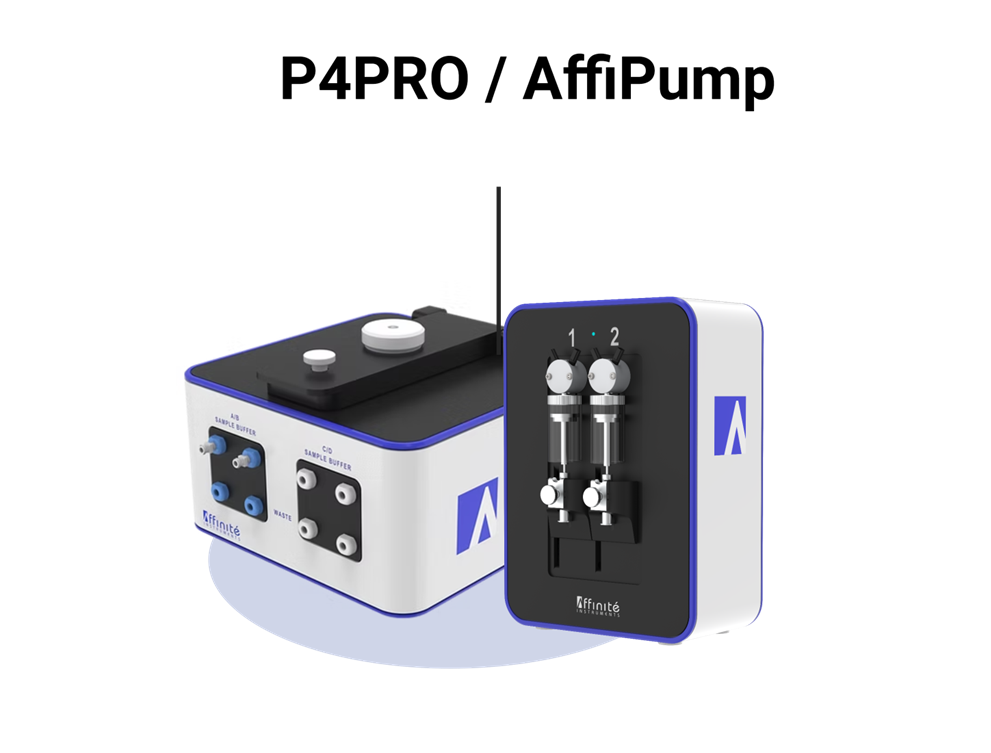
At the core of Affinité's innovation is a proprietary lensless SPR technology, paired with a custom optical design and advanced data processing algorithms. This enables an ultra-compact, flexible SPR module capable of producing high-resolution kinetic profiles in real-time, without the need for labels or complex workflows.
Whether used as a rapid-access tool in individual research labs or as a complementary platform alongside existing label-free technologies in core facilities, Affinité delivers versatility across a wide range of applications — from traditional protein-protein interactions to more challenging targets such as aptamers, membrane proteins, peptides, exosomes, adeno-associated viruses (AAVs), and virus-like particles (VLPs).
How do the P4PRO and AffiPump work?
Affinité's P4PRO is a 4-channel SPR instrument designed to bring both throughput and experimental flexibility to the bench. Its intelligent dual-pairing architecture allows experiments to be conducted simultaneously in channel pairs (A & C or B & D), giving researchers the ability to optimize parameters in one pair while reserving the other for immediate follow-up studies or entirely different experiments.
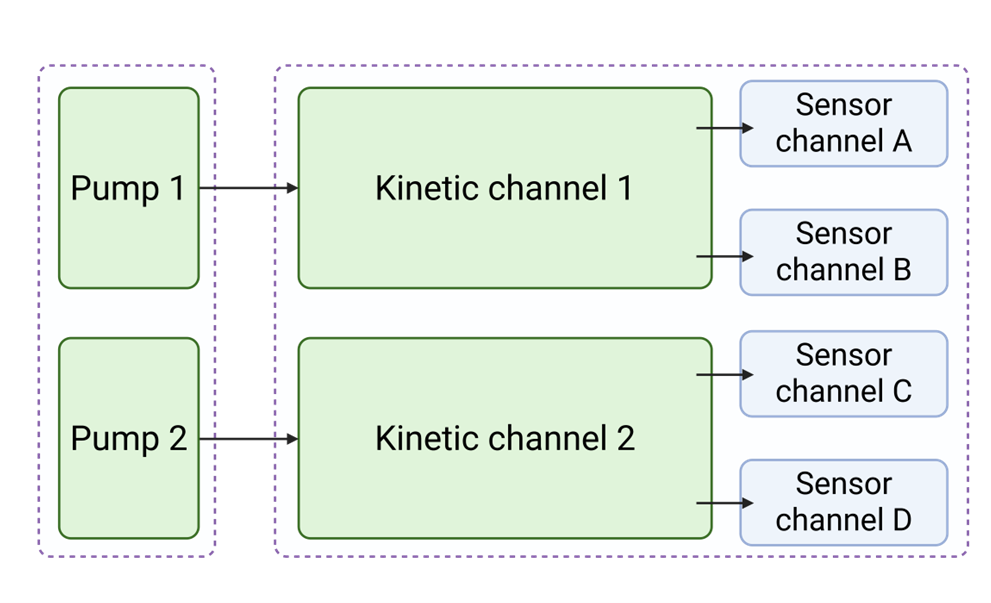
This modular approach not only streamlines experimental workflows but also doubles sensor utilization, significantly reducing the cost per data point and maximizing the value of each sensor chip.
To ensure high-quality kinetic measurements across all four channels, P4PRO is equipped with Affinité's proprietary AffiPump — a high-precision fluidic control system that delivers stable, consistent flow rates essential for accurate binding data.
What does an SPR run look like?
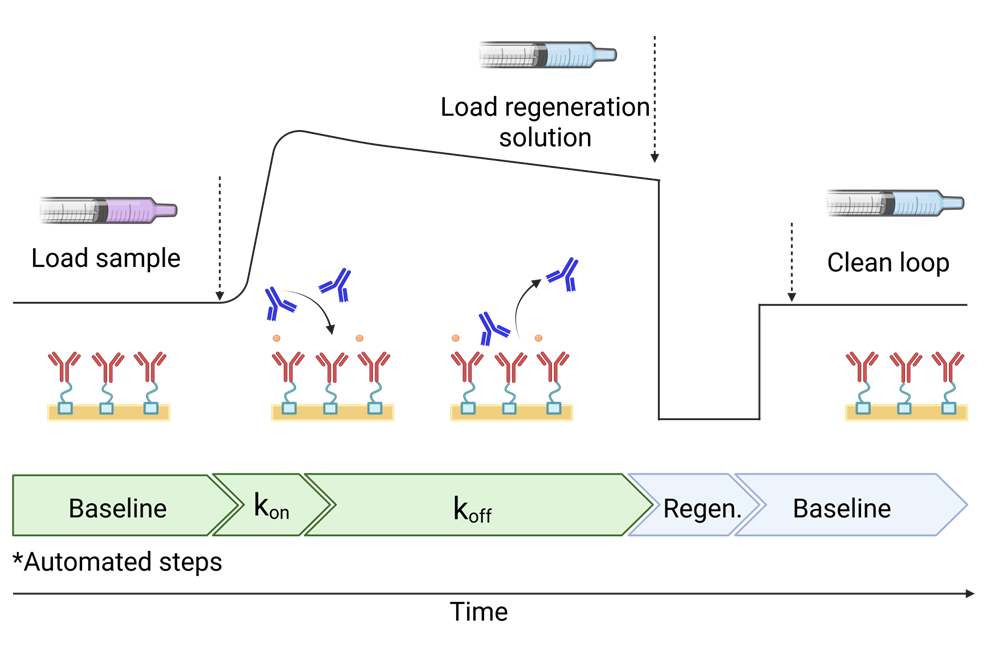
An SPR cycle generates a sensorgram: a real-time plot that captures the interaction between biomolecules across distinct phases — baseline, association, and dissociation. After immobilizing the ligand on the sensor surface, the user injects the analyte sample at a defined concentration. The association phase begins as the analyte binds to the ligand, followed by the dissociation phase, where binding is monitored after the injection stops and buffer flows across the surface.
To complete the cycle, a regeneration solution is injected to disrupt the interaction and restore the sensor surface for reuse. A buffer wash then cleans the injection loop to prevent cross-contamination before the next sample concentration is tested. This process is repeated across multiple analyte concentrations to generate a full kinetic profile, enabling accurate calculation of binding rates and affinity constants.
Protein A – IgG Binding Kinetic Setup
The Protein A–IgG interaction is a well-characterized binding pair commonly used as a reference standard across SPR platforms. In this experiment, Protein A was immobilized on a carboxyl-functionalized AffiCoat sensor in Channel A (Ch_A), while Channel C (Ch_C) was left unmodified to serve as a reference. A series of increasing IgG concentrations (0.41 nM, 11.1 nM, 33.3 nM, and 100 nM) was then injected over both channels. Glycine regeneration was performed between each concentration to restore the sensor surface for subsequent cycles.
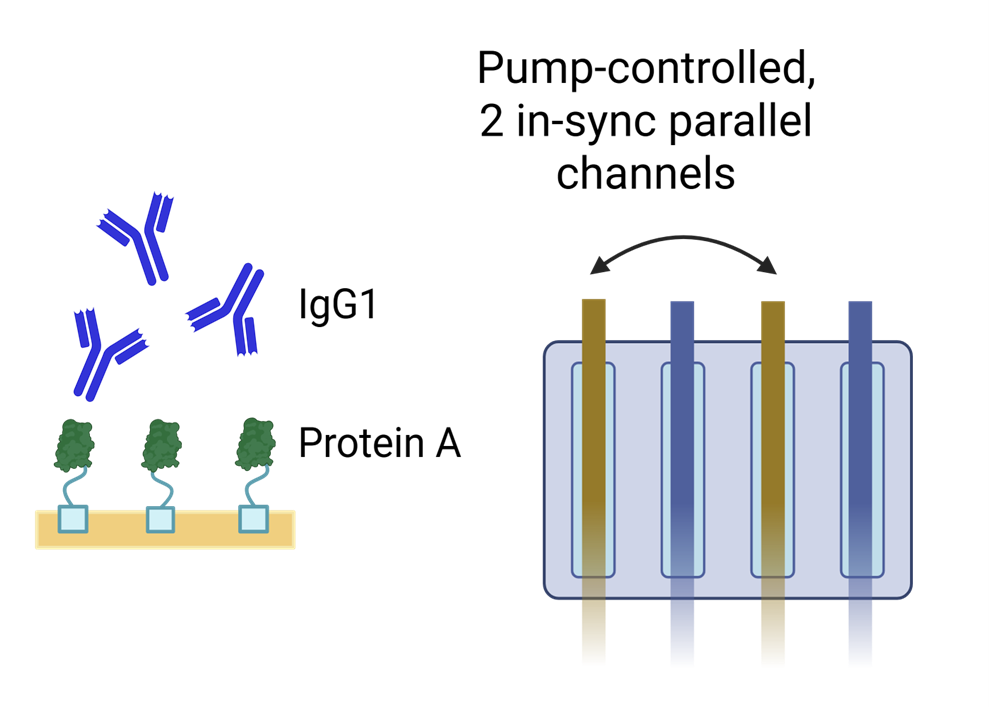
For each SPR cycle, reference subtraction was performed by subtracting the signal of the reference channel from the sample channel. This step corrects for temperature drift, bulk refractive index changes, and nonspecific binding, ensuring cleaner and more accurate data. The reference-corrected sensorgrams were then imported into TraceDrawer for visualization, fitting, and kinetic analysis.
High-Quality Data with P4PRO
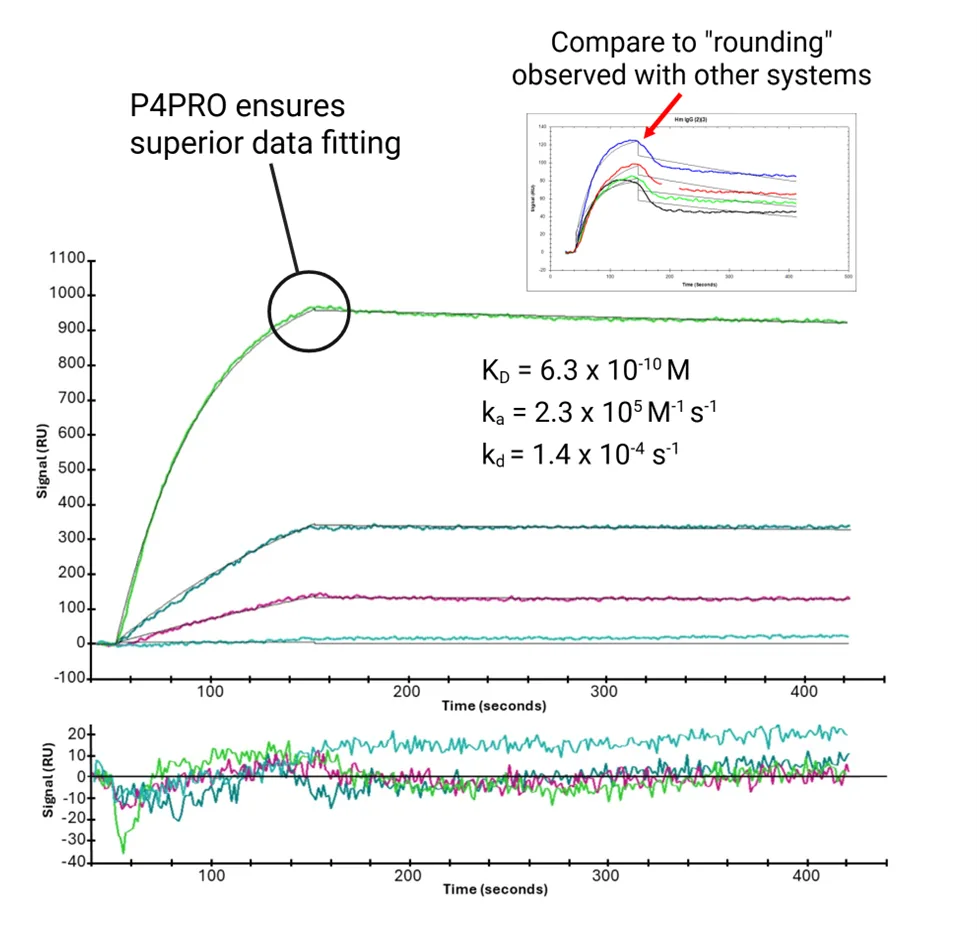
The entire Protein A–IgG experiment required less than two hours of hands-on time, demonstrating both the efficiency and ease-of-use of the P4PRO system. The resulting kinetic values — kon of 2.3 × 10⁵ M−1s−1 and koff of 1.4 × 10⁻⁴ s−1 — gave a KD of 0.63 nM, consistent with values reported in the literature.
The quality of the dataset is critical for generating accurate kinetic fits and accurate binding constants. In this example, the residual plot — which shows the difference between experimental and fitted data — demonstrates excellent agreement, with data points evenly scattered around zero. This indicates a high-confidence fit.
In contrast, data from another benchtop SPR system highlights a poor fit resulting from suboptimal fluidic control. In many entry-level SPR systems, imprecise buffer switching leads to rounded sensorgram profiles, distorting the association and dissociation phases and producing kinetic parameters with high uncertainty. Affinité's high-performance fluidics and precise sample handling eliminate these issues, ensuring clean sensorgrams, reproducible data, and reliable kinetic analysis.
The kinetic channels in the P4PRO are carefully designed to minimize flow artifacts, preserving the integrity of association and dissociation phases. Combined with the low-pulsation performance of the AffiPump, the result is data quality that competes with higher-end SPR systems typically found in core facilities.
Conclusion
The P4PRO is an affordable, lensless benchtop SPR instrument designed to deliver high-quality, reliable kinetic data. In addition to its precision performance, P4PRO offers several key advantages:
AffiPump Fluidics
Rapid and precise buffer-sample-buffer switching for clean, artifact-free sensorgrams.
4-Channel Design
Flexible, parallel experimentation with optimized sensor usage and reduced cost per data point.
Wide Sensor Compatibility
4 essential surface chemistries and support for over 30 advanced, customizable surfaces.
Compact & Low-Maintenance
Minimal footprint, ideal for individual labs or core facilities — no specialist required.
P4PRO brings powerful SPR capabilities to the benchtop, empowering scientists to accelerate their research.