Localized surface plasmon resonance (LSPR) and surface plasmon resonance (SPR) both detect binding the same way: molecules arriving at a metal surface change the local refractive index, and that shifts a plasmon resonance. The difference is the metal. SPR uses a continuous thin gold film, where the plasmon travels along the surface. LSPR uses metal nanoparticles, where the plasmon is confined to each particle.1–3 That one difference changes how far the sensor sees, what optics it needs, and what it is good at.
Side by side
| SPR (thin film) | LSPR (nanoparticles) | |
|---|---|---|
| Sensing depth | ~200–300 nm | Tens of nm or less2,3 |
| Bulk refractive-index sensitivity | High | Much lower3,4 |
| Bulk and temperature effects | Larger; handled with reference channels | Smaller, because the field is short3 |
| Signal vs. distance from surface | Decays slowly: for typical protein layers, close to proportional to bound mass | Strongly distance-dependent; depends on where the molecule sits in the field5,6 |
| Optics | Prism coupling, reflected light | Transmission or scattering, no prism2 |
| Light and sample | Light stays in the prism; opaque samples are fine | Light usually crosses the sample |
| Reproducibility | Uniform gold films | Depends on particle size and shape uniformity3 |
| Surface chemistry and literature | Mature, standardized1,7 | Growing, less standardized3 |
LSPR
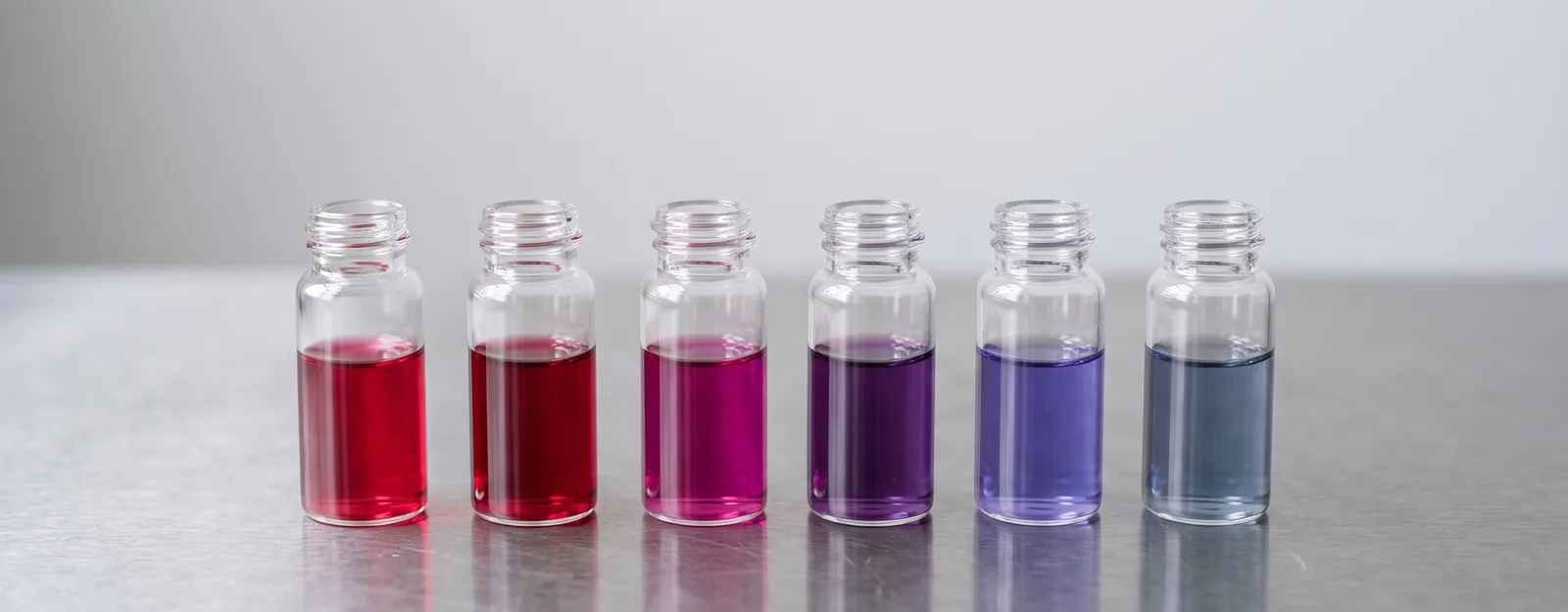
Strengths
- Short field: less affected by bulk refractive-index and temperature changes.3
- Simple optics: no prism, often a basic absorbance or scattering measurement.2
- Particles can be patterned into arrays or read on a single particle.6
Limitations
- Lower bulk sensitivity, and a signal that falls off steeply with distance from the particle.4,6
- Large targets such as vesicles or cells sit largely outside the field.
- Results depend on nanoparticle size, shape and uniformity, which makes reproducibility harder.3
- Response is not a simple measure of bound mass, which complicates quantitation.5
SPR
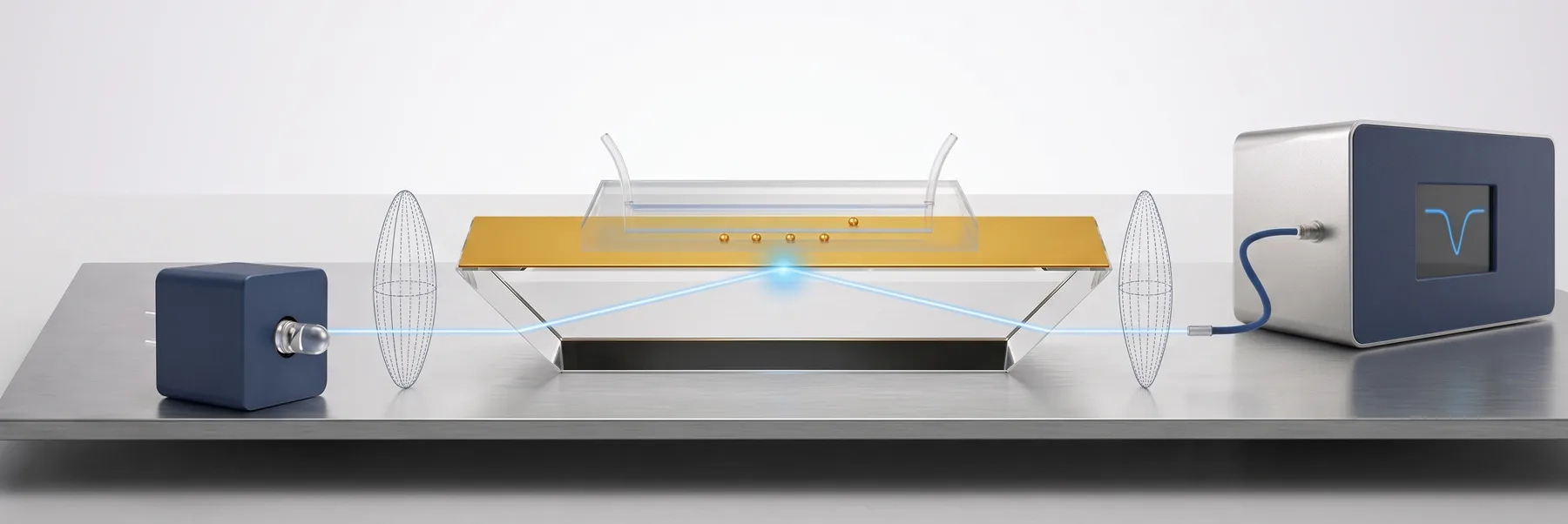
Strengths
- Deeper field: suits proteins, antibodies, vesicles and other large targets.
- Light never crosses the sample, so serum, plasma and lysates can be measured directly.
- Signal tracks bound mass, the basis of decades of kinetic and affinity methods.1,7
- Uniform gold films and well-established surface chemistries.1
Limitations
- More sensitive to bulk refractive-index and temperature changes; needs good referencing.
- Prism coupling traditionally means more complex optics and larger instruments.1
- Small molecules give small signals and demand a very stable baseline.
What a head-to-head study shows
Van Duyne's group compared the two directly, measuring the same protein–carbohydrate interaction on a gold film and on silver nanoparticles.5 Both sensors followed the association phase similarly. In the dissociation phase they diverged, and the authors traced the difference to the nanoparticle field decaying over a distance comparable to the size of the protein itself. A later comparison on identical molecular layers found the same pattern: the smaller the particle, the more non-linear the signal with layer thickness.6
Neither result makes one technique better. They show that LSPR reports where molecules sit as much as how many are there, while thin-film SPR responds more simply to bound mass.
Which should you use?
LSPR is a good fit when targets are small and bind close to the surface, when bulk effects are hard to control, or when you need very simple, low-cost optics.
SPR is a good fit when targets are larger, samples are complex, and you want quantitative kinetics and affinity backed by an established body of methods.
The usual argument for LSPR, simpler and smaller optics, has been weakening as thin-film SPR itself gets smaller. Our instruments use thin-film SPR in the Kretschmann configuration with the complex optics taken out; see how lensless SPR works.
References
- J. Homola, "Surface plasmon resonance sensors for detection of chemical and biological species," Chemical Reviews 108 (2008) 462–493. doi:10.1021/cr068107d
- K. A. Willets and R. P. Van Duyne, "Localized surface plasmon resonance spectroscopy and sensing," Annual Review of Physical Chemistry 58 (2007) 267–297. doi:10.1146/annurev.physchem.58.032806.104607
- K. M. Mayer and J. H. Hafner, "Localized surface plasmon resonance sensors," Chemical Reviews 111 (2011) 3828–3857. doi:10.1021/cr100313v
- A. J. Haes and R. P. Van Duyne, "A unified view of propagating and localized surface plasmon resonance biosensors," Analytical and Bioanalytical Chemistry 379 (2004) 920–930. doi:10.1007/s00216-004-2708-9
- C. R. Yonzon, E. Jeoung, S. Zou, G. C. Schatz, M. Mrksich and R. P. Van Duyne, "A comparative analysis of localized and propagating surface plasmon resonance sensors: the binding of concanavalin A to a monosaccharide functionalized self-assembled monolayer," Journal of the American Chemical Society 126 (2004) 12669–12676. doi:10.1021/ja047118q
- J. Jatschka, A. Dathe, A. Csáki, W. Fritzsche and O. Stranik, "Propagating and localized surface plasmon resonance sensing — a critical comparison based on measurements and theory," Sensing and Bio-Sensing Research 7 (2016) 62–70. doi:10.1016/j.sbsr.2016.01.003
- M. Hojjat Jodaylami, J.-F. Masson and A. Badia, "Surface plasmon resonance sensing," Nature Reviews Methods Primers 5 (2025) 47. doi:10.1038/s43586-025-00417-8