Lensless SPR™ technology

SPR precision, moved from the optics to the signal.

You know us for SPR instruments. Inside every P4SPR 2.0 and P4PRO is a Kretschmann SPR instrument with the complex optics taken out. Here is how it works, and why we built it that way.
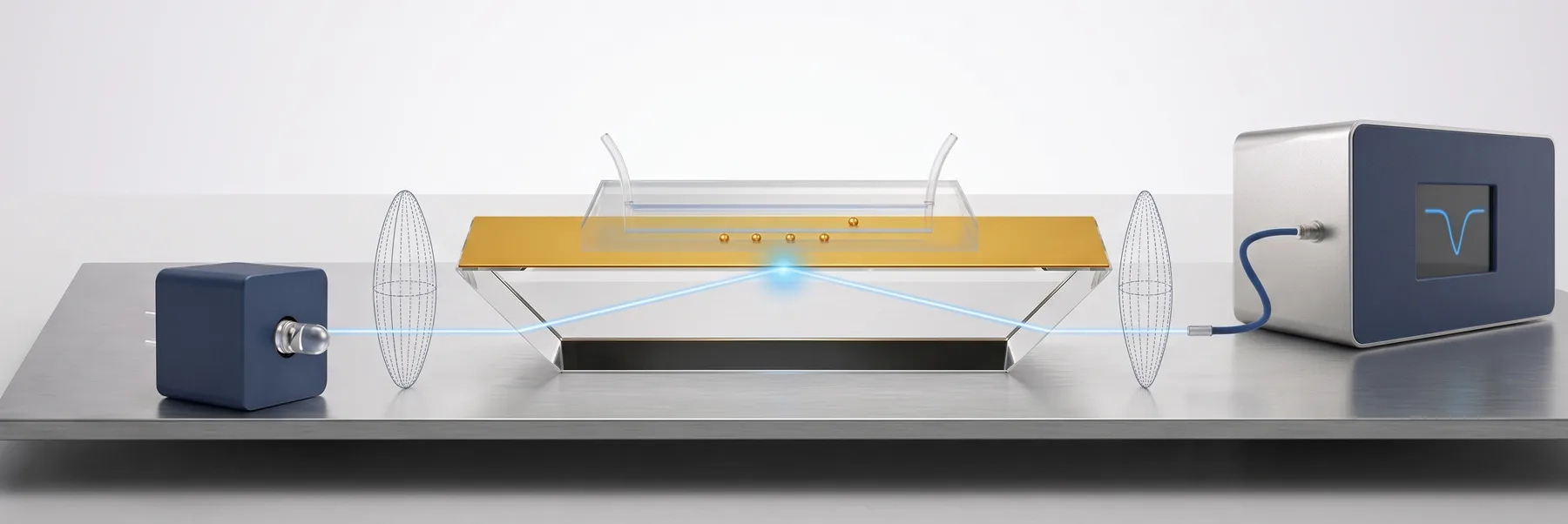
One LED, one gold sensor surface under a flow channel, one detector. Dashed outlines mark where a conventional instrument would need lenses.

One LED, one sensor, one detector. The dashed outlines mark where conventional SPR puts its lenses.

The barrier

Performance at any cost and complexity.

SPR was commercialized for centralized labs and the experts who run them. The goal was maximum sensitivity: picking up the tiny signals from small analytes at low concentrations.

That takes a large, complex optical system: focusing lenses to shape the beam, a polarizer to select the light that excites the plasmon, a rotating stage to set the angle, and another focusing lens in front of the detector. Every element has to stay precisely aligned, and every extra channel needs its own set.

Conventional SPR precision lives in the optics focusing lenses angle mechanics polarizer focusing lens detector Lensless SPR™ precision lives in the geometry and the signal polarizer peak tracking aperture fixed angle detector shorter light path, no lenses to house conventional length
Simplified. In a lensless instrument, the parts that used to need adjusting are replaced by fixed, machined geometry, so the whole light path gets shorter.
How lensless SPR works

We removed the complexity, not the measurement.

Lensless SPR is designed for a different user and a different measurement: the researcher at their own bench, running binding experiments on larger targets in real, complex samples. Those experiments produce larger shifts, so maximum sensitivity isn't the goal; a dependable reading of where the resonance moves is.

We got there with three design decisions.

1

Keep the Kretschmann configuration

gold film total internal reflection

Light reflects under a thin gold film on a prism by total internal reflection. At resonance, part of that light couples into surface plasmons in the gold and a dip appears in the reflected light. Its position depends on what binds to the surface.

This is the same physics as conventional SPR, on purpose. Sensor surfaces, immobilization chemistries, published methods and the way data is interpreted all carry over. Only the instrument around it changed.

Technical note

Three ways to excite a surface plasmon

Light shining straight onto a metal can't excite a surface plasmon; it needs extra momentum along the surface. There are three classic ways to give it that.

gapmetal

Otto

A small gap, about one wavelength, separates the prism from the metal. Light reflecting in the prism excites plasmons across the gap. The gap is hard to control, so it is rarely used for biosensing.

Used in lensless SPR samplegold film on the prism

Kretschmann

A thin gold film sits directly on the prism. Light reflects under the gold and excites plasmons on the other side, where the sample is. The standard configuration for biosensing.

samplepatterned metal grating

Grating coupling

No prism: a patterned metal surface diffracts the light to excite plasmons. The light usually has to pass through the sample, and the grating must be precisely fabricated.

2

Streamline the optics

Starting from that configuration, we took out every component the measurement didn't need and replaced the rest with fixed geometry.

Conventional SPRLensless SPR
Collimating and focusing lenses
Aperture tunnels machined into the light path shape the LED light
Rotating stage and angle scanning
Wavelength interrogation at a fixed angle: a broadband LED and a spectrometer read the resonance by colour
Hemispherical prism, source and detector on angled arms
Dove prism: light leaves on the same axis it enters, so the whole path is one straight line
Polarizer
Polarizer, kept
A full optical train for each channel
One LED and one sensing area per channel, with fibres feeding one shared spectrometer
3

Offset with data and assay design

Fewer optical components means a less refined raw signal. We offset that where it is cheaper and more flexible to do so:

Data processing. Peak tracking follows the resonance position across the full spectrum, rather than the intensity at a single wavelength. Reference channels subtract bulk refractive-index changes and drift.

Assay strategy. Surface chemistries and experimental designs chosen for the larger shifts that larger targets give in complex samples.

Nothing to align, nothing to move, and every channel is a copy of the first.

What it means for you

The instrument is no longer the hard part.

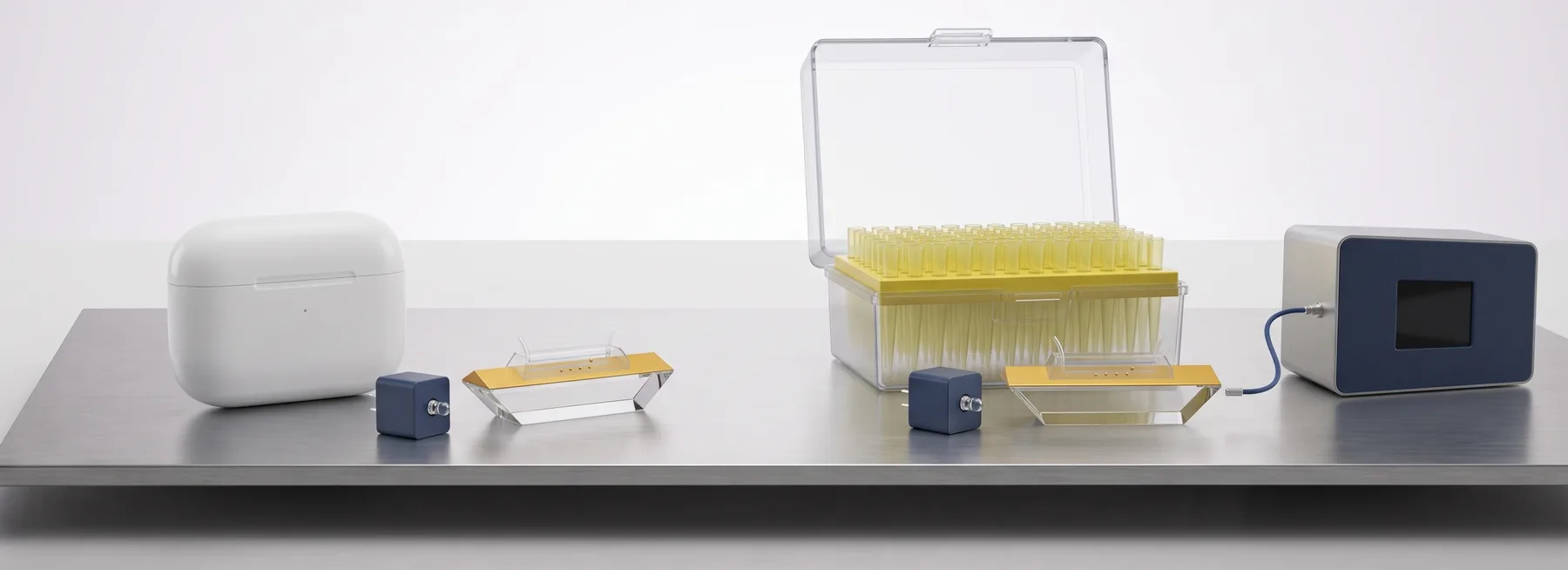
When the light path is a machined part, an SPR instrument can be small, simple, and identical from one channel to the next. The lensless optical module fits within the footprint of an earbud case; add the detector and the whole measurement is about the size of a pipette-tip box. A full instrument can even travel in a carry-on and run on arrival.

That moves the real challenge to where your biology is. It's also where we now put most of our effort, alongside you.

Illustration: a lensless SPR optical module beside an earbud case, and the module with its detector beside a pipette-tip box.
Illustration, for a sense of size.
LenslessSPR™, an Affinité Instruments technology

Patented lensless surface plasmon resonance technology.