A quick-reference guide to the two core SPR measurement modes — when to use each, what data you get, and how to interpret the results.
Main Differences
| Static | Kinetic | |
|---|---|---|
| Use Case | Screening and possibly Apparent KD determination | Real-time binding; determination of Quantitative KD, ka, kd |
| Analyte types & average size | Peptides, antibodies, proteins, complexes; 10 kDa – 500 kDa | Small: haptens, peptides, antibodies, nanoparticles, vaccines; 100+ Da |
| No. of experiments | Up to 4 independent experiments | ≥ 2 (up to 2 independent experiments per run) |
| Sample injection type | Manual | Semi-automated |
| Sample amount | > 10 µg | ~10 µg |
| Detection methods | Western blot, ELISA, immunoprecipitation assay, isothermal calorimetry | Isothermal calorimetry, surface chemistry, isothermal titration calorimetry |
Static SPR
Purpose: Scouting or screening prior to Kinetic SPR, yes/no binding.
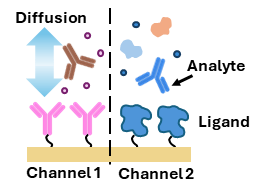
- Like label-free ELISA: ligand-analyte interaction depends on diffusion, concentration, and binding strength measured as Apparent KD
- Concentration determination of active analyte in complex media (e.g. crude lysate)
- Quick verification of protein expression
- Contact time ~ seconds to hours so slow interactions can be measured with Static SPR
- Low viscosity buffers and biomolecules 10–500 kDa are recommended
- Up to 4 independent experiments (4 channels) for P4 SPR device
Flow (Kinetic) SPR
Purpose: Sensitive, quantitative binding characterization.
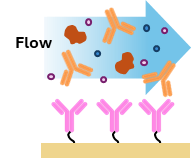
- Constant flow of analyte enables ligand-analyte interaction so both strength and rate of binding are measured as Quantitative KD
- Can transfer Static SPR conditions to Kinetic SPR
- Due to controlled flow, Kinetic SPR can accommodate a broader range of molecule sizes (100+ Da)
- Suitable for low analyte concentrations, better real-time sensitivity
Data Output Differences
Static SPR Data
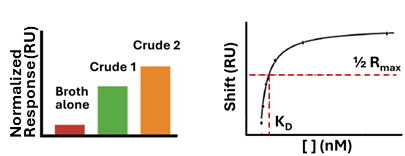
- Association without dissociation
- End-point response units are analyzed
- Like ELISA, Apparent KD can be estimated at ½ RU max determined by concentration titration
Flow SPR Data
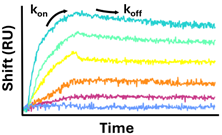
- Both association and dissociation
- Quantitative KD calculated by koff/kon
- Steeper upward curve → faster association
- Steeper downward curve → faster dissociation