Resources · SPR Guide

Decoding SPR Sensorgrams

A field guide to every sensorgram shape we've seen across hundreds of labs in 10 countries — what it means, and how to fix it.

← Back to Resources
What are you seeing? No signal High signal Baseline rising Baseline drifting Spikes / drops Noisy data Slow dissociation Poor model fit Clear filter

No exact match

Try a different symptom, or contact us — we've likely seen it.

1
Setup & Ligand Issues
Problems with ligand immobilization, regeneration, and sensor chip preparation.

The 5 Phases of a Sensorgram (BASDR)

RU Time → kon KD equilibrium koff ↺ replay Analyte Ligand (immobilized) Gold film
B
Baseline
Buffer flows over the sensor, establishing a stable reference signal.
A
Association
Analyte moves to the surface via mass transport and binds to the ligand.
S
Steady-State
Net rate of bound analyte is zero. Saturation may or may not be reached.
D
Dissociation
Buffer returns; analyte dissociates from the ligand.
R
Regeneration
Low pH buffer removes remaining bound analyte to restore the surface.
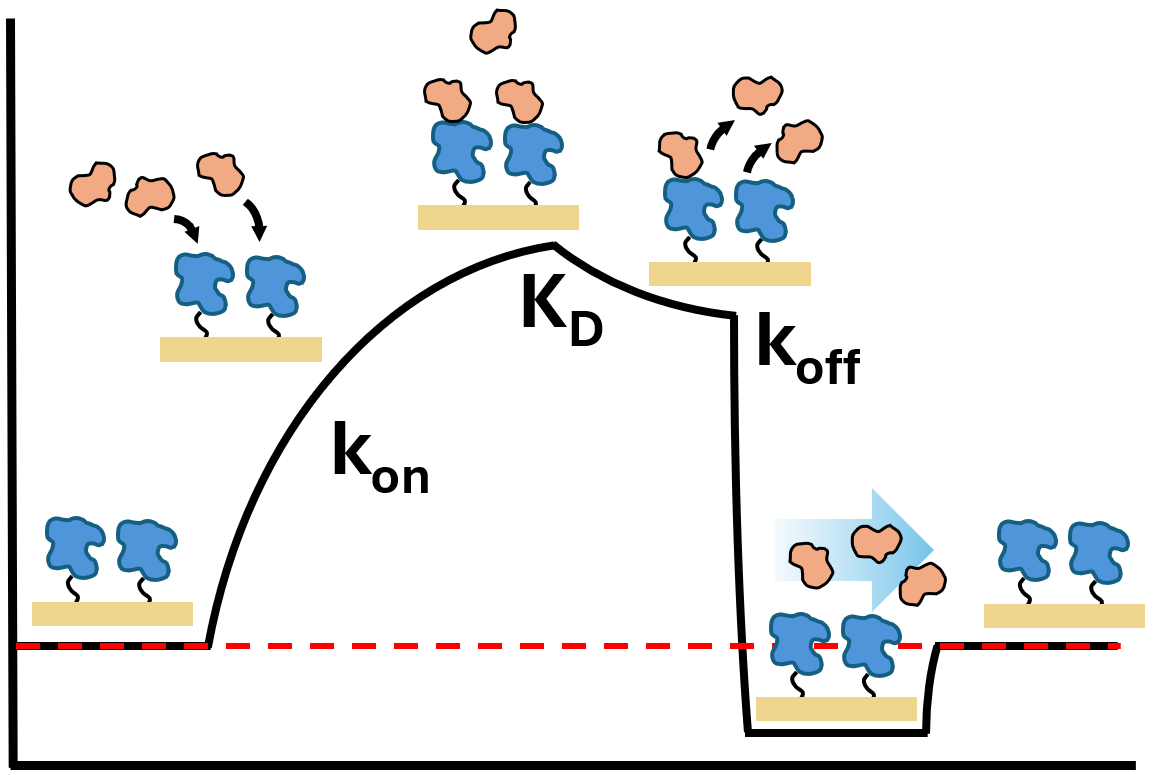
k_on / K_D / k_off — SPR binding kinetics diagram
Setup No signal
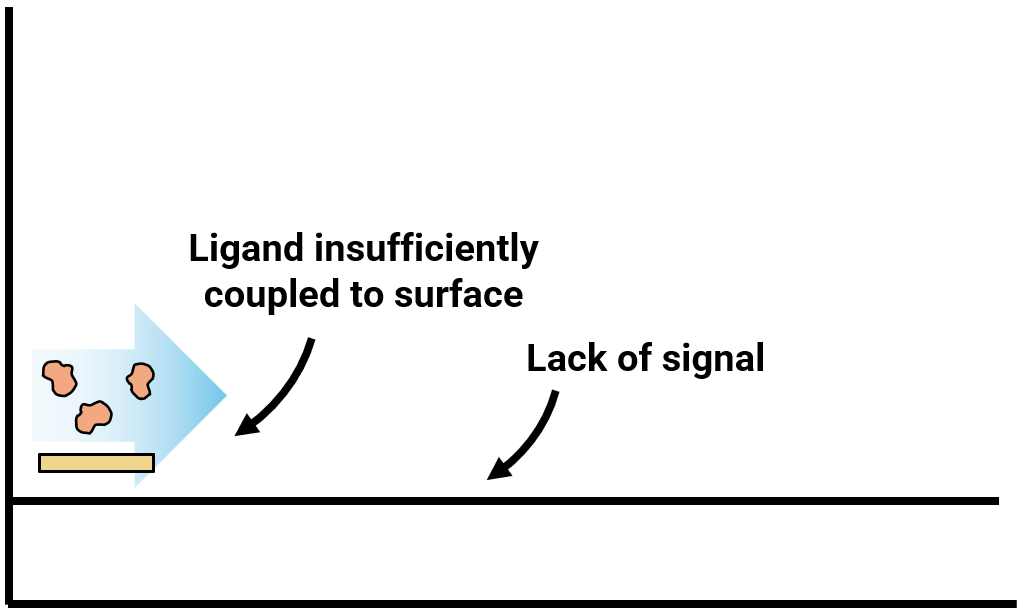
Insufficient Ligand Immobilization
Symptoms
  • Low or no RU response after analyte is flowed
  • Flat sensorgram with no binding signal
Fix
  • Increase ligand concentration
  • Increase coupling time
  • Change surface chemistry
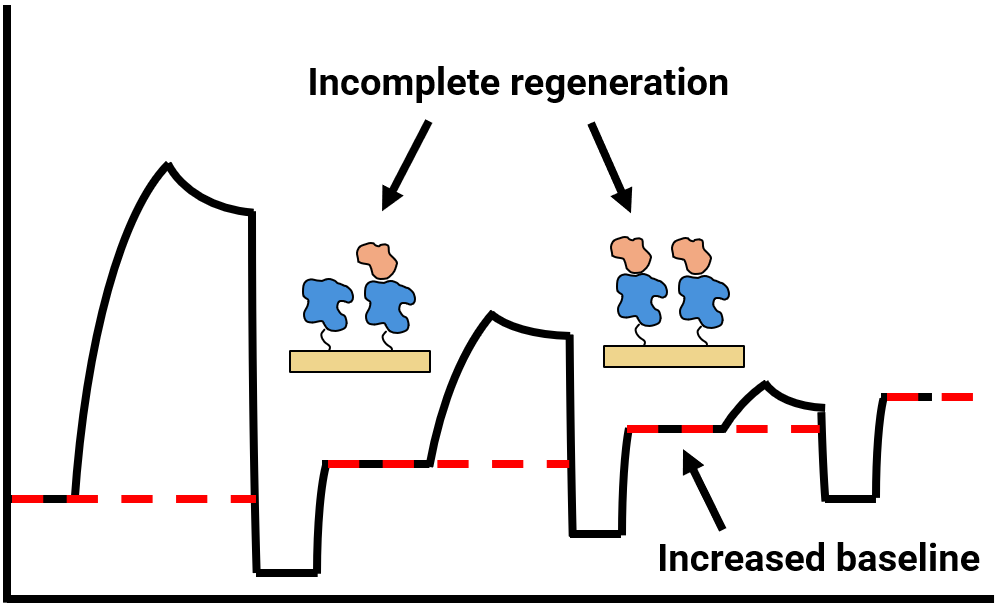
Incomplete regeneration — progressive baseline
Setup Baseline rising
Incomplete Surface Regeneration
Symptoms
  • Analyte not fully cleared between cycles
  • Progressive baseline increase across runs
  • Reduced binding capacity in subsequent cycles
Fix
  • Optimize regeneration buffer composition, pH, and ionic strength
  • Follow with original running buffer to re-establish baseline
  • Check for non-specific binding; increase flow rate and regeneration time
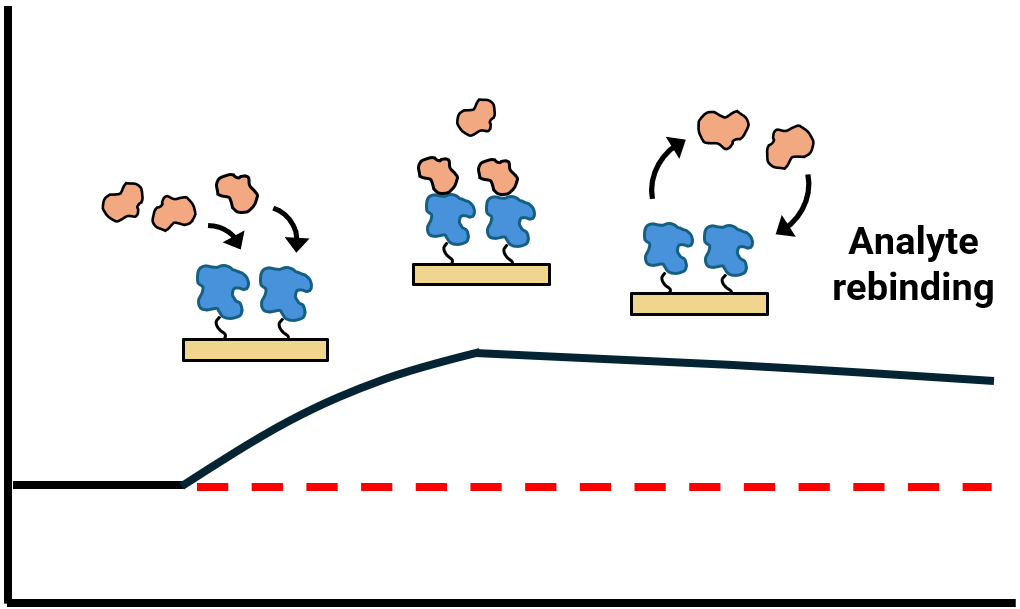
Rebinding — flat dissociation
Setup Slow dissociation Poor model fit
Rebinding Effects
Symptoms
  • Analyte rebinds to nearby ligands after dissociation
  • Dissociation does not follow a single exponential
  • Baseline never recovered in dissociation phase
Fix
  • Decrease ligand density on sensor; increase flow rates
  • Use single-cycle kinetics
  • Inject soluble ligand as competitor during dissociation
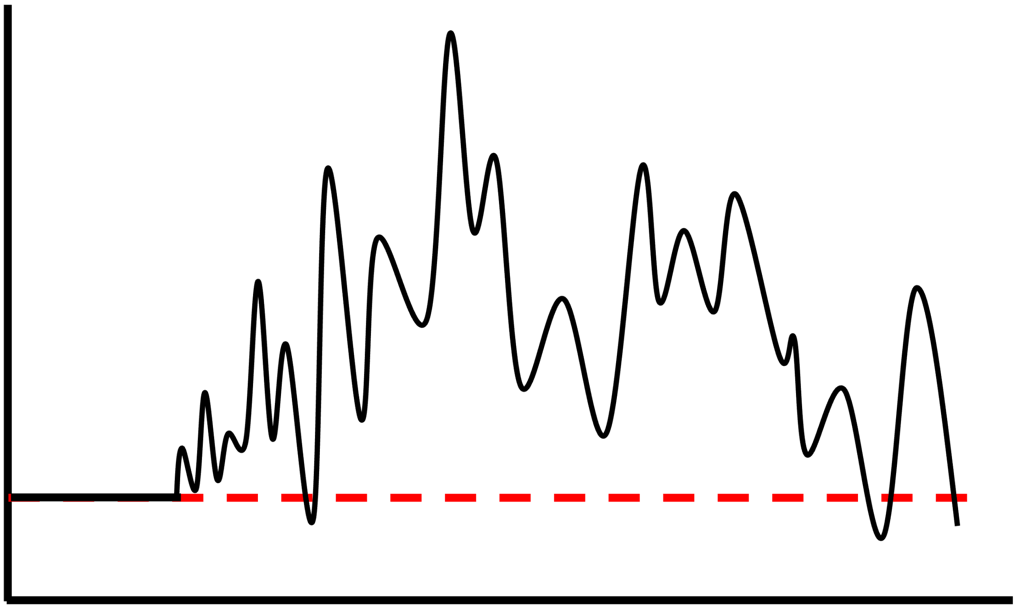
Noisy sensorgram
Setup Noisy data
Noisy Data
Symptoms
  • High noise obscuring binding signal
  • Erratic RU fluctuations across the entire run
Fix
  • Increase analyte concentration
  • Increase amount of immobilized ligand on sensor
2
Assay Issues
Issues arising from analyte preparation, buffer composition, and assay conditions.
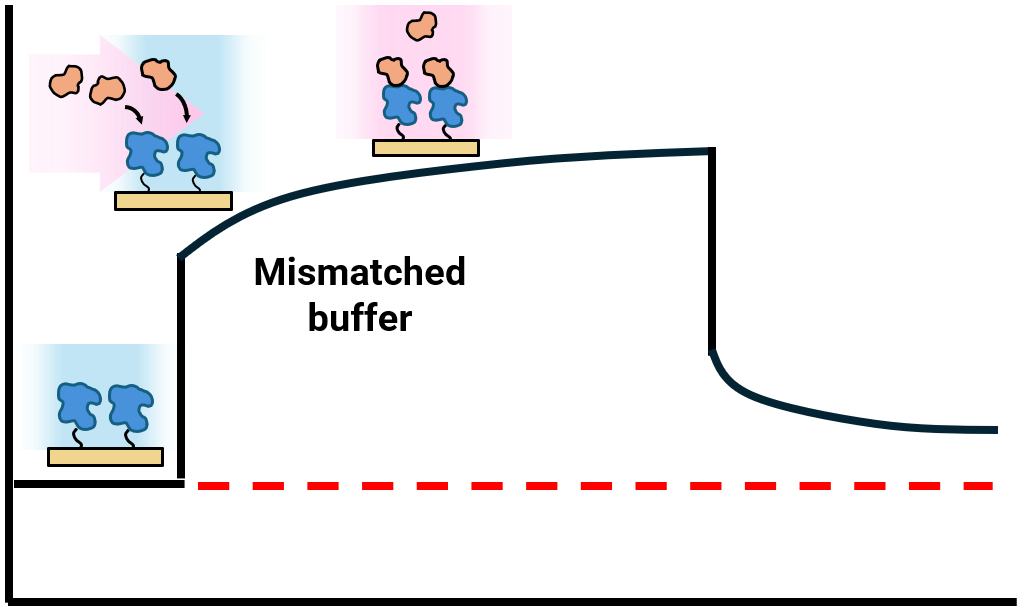
Buffer mismatch — bulk shift
Assay High signal Poor model fit
Buffer Mismatch (Bulk Shift)
Symptoms
  • Square-shaped artifact in the binding curve
  • Large, rapid RU changes at start and end of injection
  • Analyte and running buffer compositions differ
Fix
  • Match analyte buffer components with running buffer
  • Dialyze or filter analyte into the same running buffer
  • Run buffer-only reference and subtract from analyte experiment
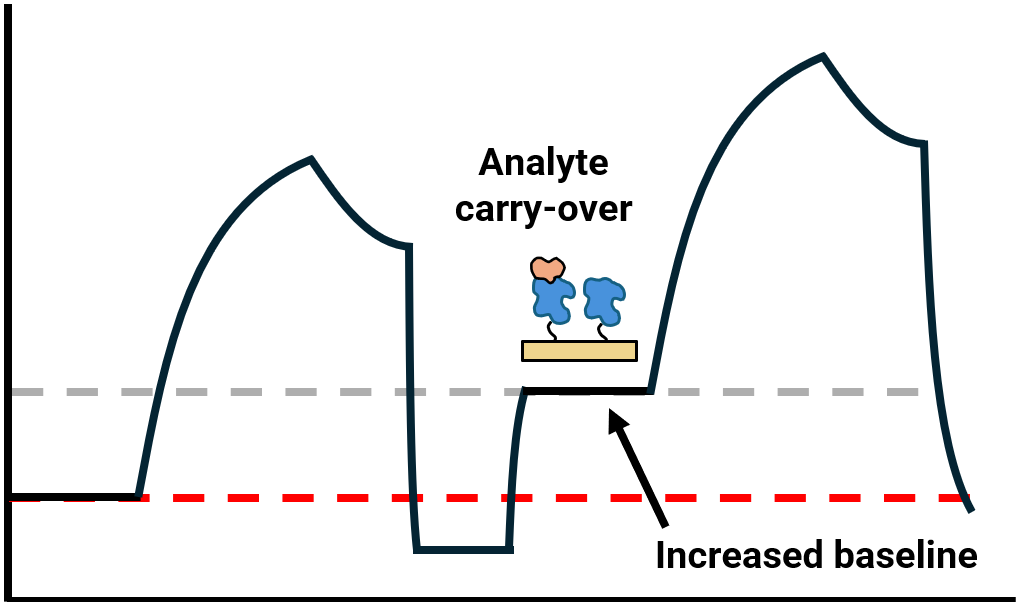
Carryover — increased baseline
Assay Baseline rising Spikes / drops
Carryover Between Cycles
Symptoms
  • Baseline increases across subsequent cycles
  • Sudden buffer jumps or spikes at the start of analyte injection
  • Often caused by high salt or sticky analyte
Fix
  • Verify complete regeneration between cycles
  • Reformulate analyte buffer
  • Add extra washing steps between injections
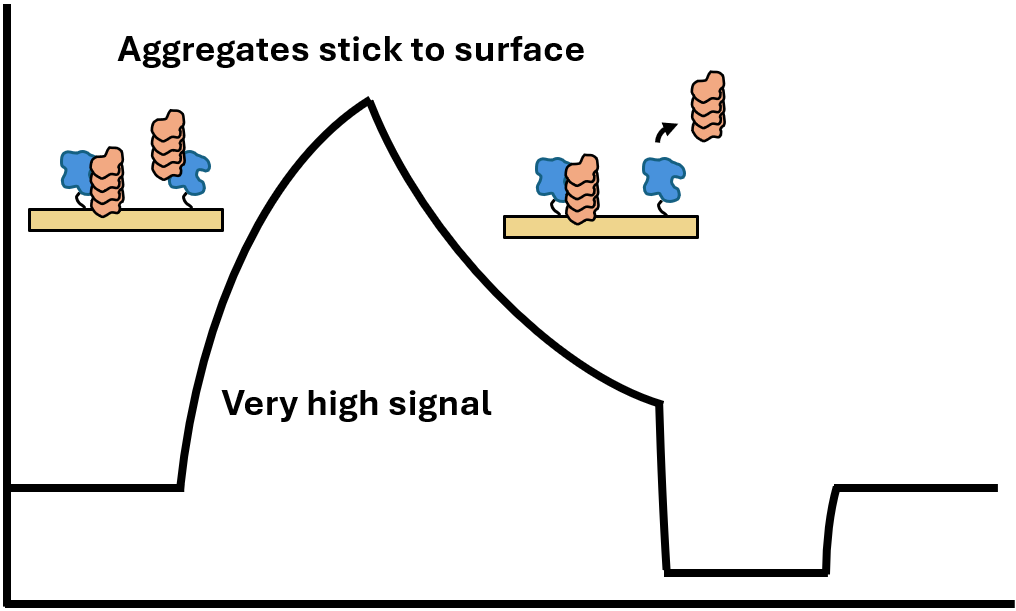
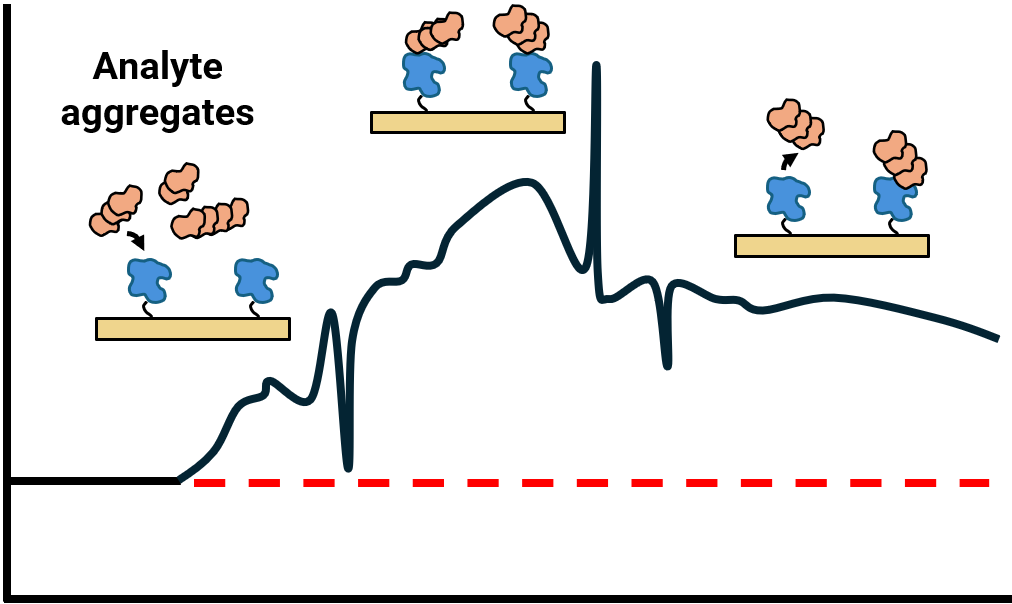
Aggregation — very high signal Aggregation — erratic curve
Assay High signal Noisy data Spikes / drops Poor model fit
Analyte Aggregation
Symptoms
  • Erratic, irregular or noisy binding curves
  • Sharp transient spikes or jumps in signal
  • Abnormally high RU and poor model fitting
Fix
  • Check protein folding and monodispersity
  • Reformulate analyte buffer; replenish with fresh soluble analyte
  • Filter or centrifuge to remove aggregates before injection
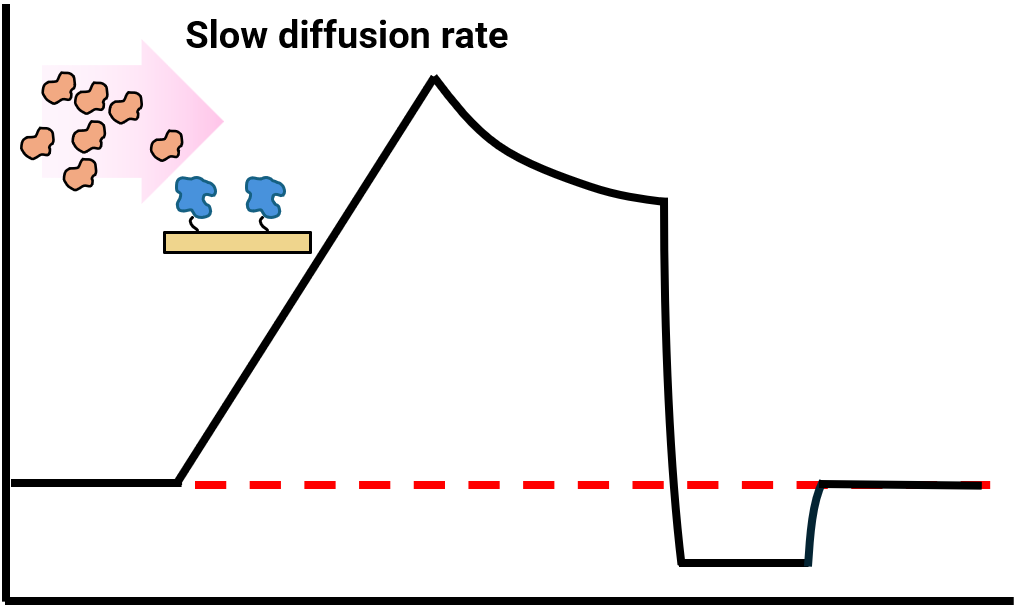
Mass transport limitation
Assay Slow dissociation Poor model fit
Mass Transport Limitations (MTL)
Symptoms
  • Slow, gradual RU increase during association — faster at higher flow rates
  • Analyte diffusion slower than binding rate
  • Poor data modeling at low analyte concentrations
Fix
  • Use higher flow rates and low-viscosity buffer
  • Decrease ligand density on the sensor
  • Use MTL-corrected models for data fitting
P4PRO is designed to minimize MTLs by delivering analyte quickly and evenly across the sensor surface.
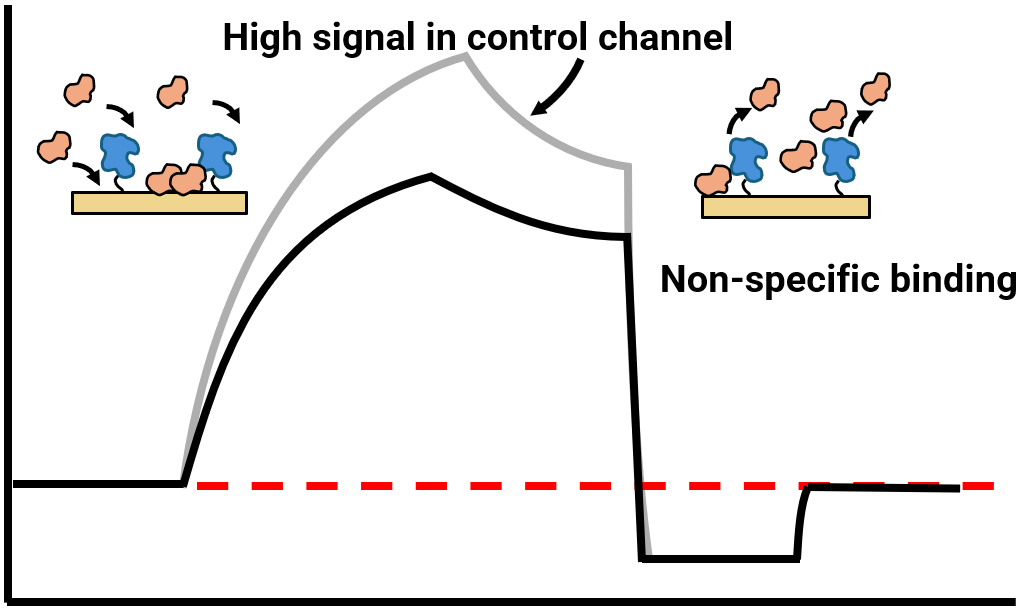
Non-specific binding — high reference channel
Assay High signal Poor model fit
Non-Specific Binding (NSB)
Symptoms
  • Steep RU increase from analyte interaction with sensor surface
  • High signal in reference channel — reflects diffusion, not binding
  • Poor model fitting
Fix
  • Increase salt concentration; adjust buffer pH
  • Add BSA or non-ionic surfactants (e.g., Tween 20)
  • Change ligand orientation or sensor surface chemistry

3
Operational, Instrumentation & Other Issues
Issues arising from instrument state, fluidics, temperature, and compound effects.
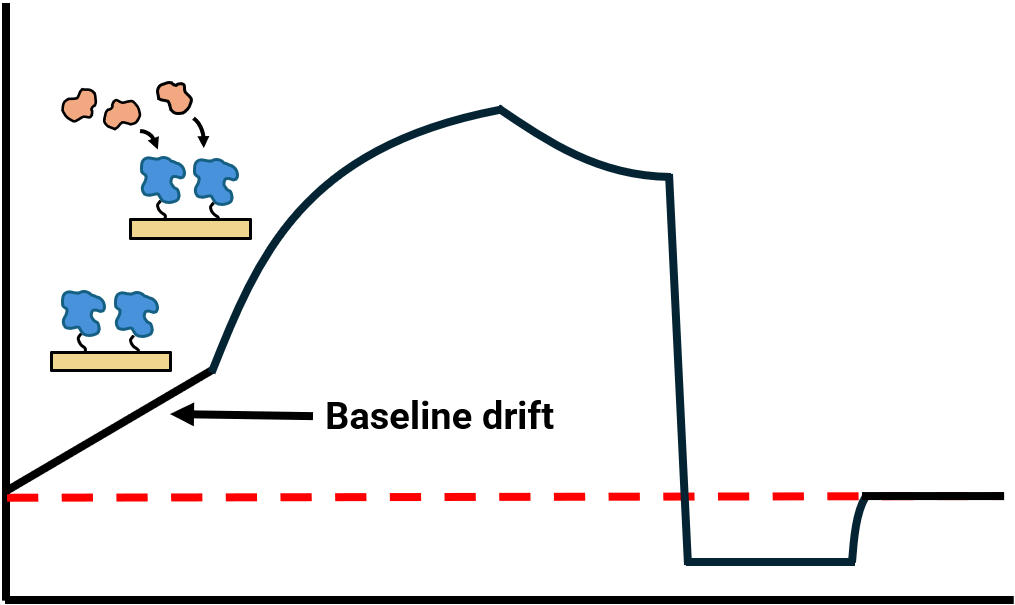
Baseline drift
Operational Baseline drifting
Baseline Drift
Symptoms
  • Gradual upward or downward RU drift during the run
  • May indicate temperature fluctuations, unstable sensor, or contamination
Fix
  • Stabilize temperature in the instrument environment
  • Replace sensor; equilibrate system with sufficient buffer
  • Flow running buffer until baseline is stable
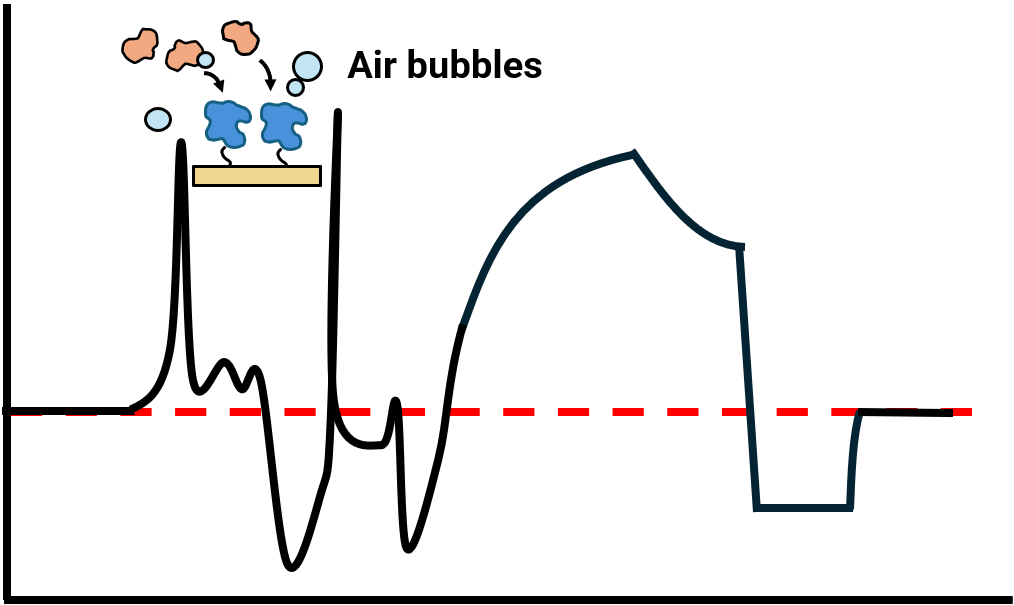
Air bubbles — unpredictable spikes
Operational Spikes / drops Noisy data
Air Bubble or Clog in Lines
Symptoms
  • Sudden, unpredictable RU spikes and drops during injection and dissociation
  • Erratic signal not correlated with binding events
Fix
  • Check instrument for fluidic leaks; purge lines
  • Degas samples before injection
  • Perform scheduled instrument maintenance
Injection failure — no RU response
Operational No signal
Injection Failure
Symptoms
  • No RU response after analyte injection
  • May be caused by valve malfunction, air in syringe, or software error
Fix
  • Check injection valves and syringe for air
  • Restart software and re-run system maintenance
Rounded peak — poor instrumentation
Instrumentation Poor model fit Slow dissociation
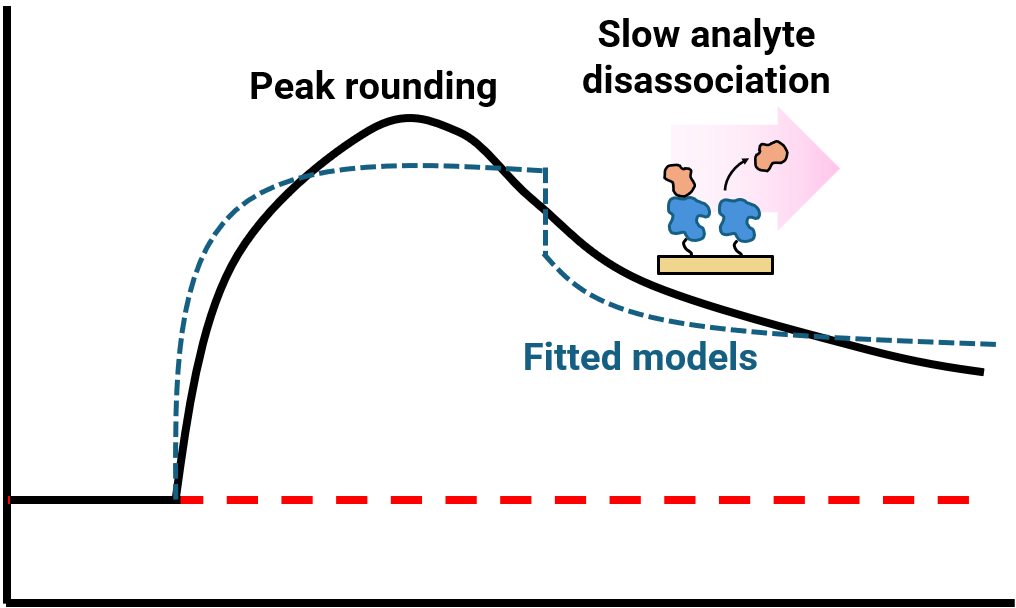
Rounded Peak
Symptoms
  • Inefficient analyte dissociation from the ligand
  • Over- or under-estimation of binding affinity
  • Poor fit with standard 1:1 global model
Fix
  • Implement a regeneration step
  • Use a fit model other than 1:1 global fit
Combination effects
Combined High signal Baseline rising Poor model fit
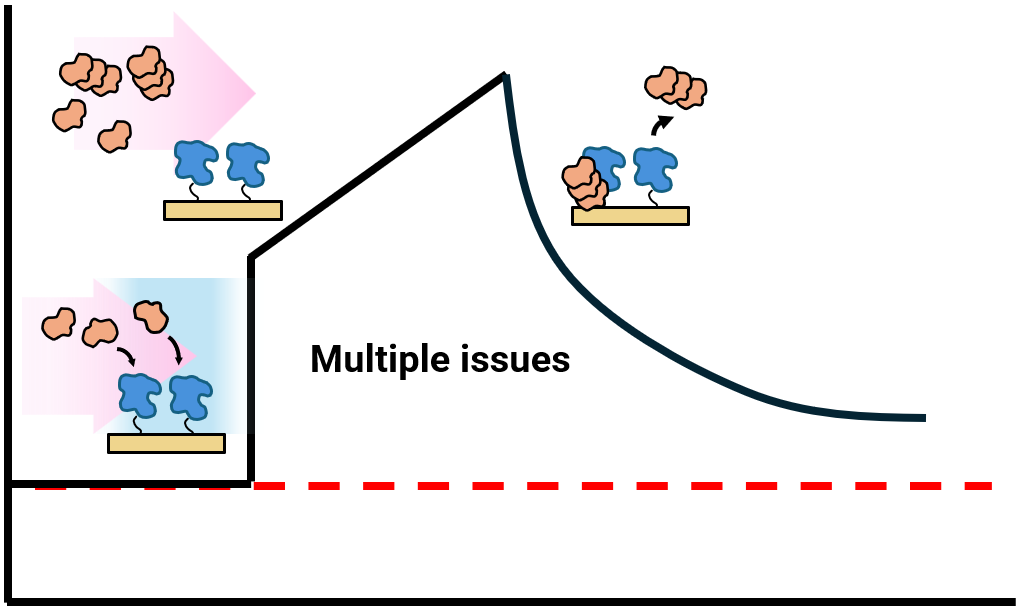
Combination Effects
Symptoms
  • MTLs, protein aggregation, and buffer mismatch simultaneously present
  • Linear upward climb during association with no equilibrium plateau
  • Steady higher baseline; poor fitting across all models
Fix
  • Diagnose each effect individually before applying fixes
  • Address buffer mismatch first, then aggregation, then MTL
  • Refer to Parts 1 & 2 for individual fix protocols
P4PRO is designed to minimize MTLs by delivering analyte quickly and evenly across the sensor surface.

Not seeing your issue?

We've worked with hundreds of labs across 10 countries. If your sensorgram doesn't match any of these patterns, we'd like to take a look.

Talk to an SPR specialist →