The lensless optical architecture isn't just what makes our instruments smaller. It's the cornerstone of the translational biosensing platform we're building — and the reason miniaturization, workflow integration, automation, and data quality are all consequences of the same design decision.
A Different Starting Point
Conventional SPR instrumentation is built around a precision optical bench: collimating lenses, a halogen or laser light source, and angular scanning mechanics that must be carefully aligned and maintained. That configuration has served large, well-resourced labs well for decades. It is also why traditional SPR instruments are large, expensive, fragile, and tethered to specialized infrastructure.
The lensless SPR architecture we patented (WO2022204814) takes a fundamentally different approach. By replacing the collimating lens system with precision aperture tunnels and a fixed-angle Dove prism geometry, we eliminated the optical components that have historically driven up instrument size, cost, and complexity. The approach uses broad-spectrum LED illumination in wavelength-interrogation mode at a fixed angle — no moving mechanical parts, no alignment routine, and an optical path roughly an order of magnitude shorter than conventional designs.
The result is not a more affordable version of existing SPR. It is a different architecture — and one that opens up a set of capabilities that prism-based systems simply cannot offer.
Miniaturization as a Consequence, Not a Goal
When you remove the optical bench, the instrument shrinks to what the measurement actually requires. Our instruments fit a standard lab bench, travel in carry-on luggage, and can be deployed in environments where a conventional SPR system cannot go — field settings, manufacturing floors, point-of-need applications. The compact footprint is a side effect of rethinking the physics, not a design compromise.
More importantly, a miniaturized optical core is also an embeddable one. The same architecture that makes portability possible makes integration tractable — into custom analytical platforms, into process monitoring workflows, into multi-modal measurement systems. Researchers are no longer organizing their workflow around the instrument. The instrument fits into the workflow.
Integration and the Path to Automation
Lensless SPR scales in a way that conventional architectures do not. Because the optical core is compact, modular, and mechanically simple, it can support increasing levels of fluidic complexity without redesign. A user can begin with manual sample injection, move to pump-assisted flow for more controlled kinetics experiments, and progress toward full autosampler integration — all on the same optical platform.
This is not a future roadmap item. It is built into the architecture: the detection core is fixed; the capability around it grows. That scalability is what makes the lensless platform a meaningful step toward automated, high-throughput SPR workflows at a price point accessible to academic and early-stage industrial labs.
Signal Quality: Chemistry, Sensors, and the Algorithm
Optical architecture gets you a compact, portable, scalable instrument. What it cannot do alone is give you reliable data. That requires the measurement environment to be controlled — and that is where the rest of the platform stack does its work.
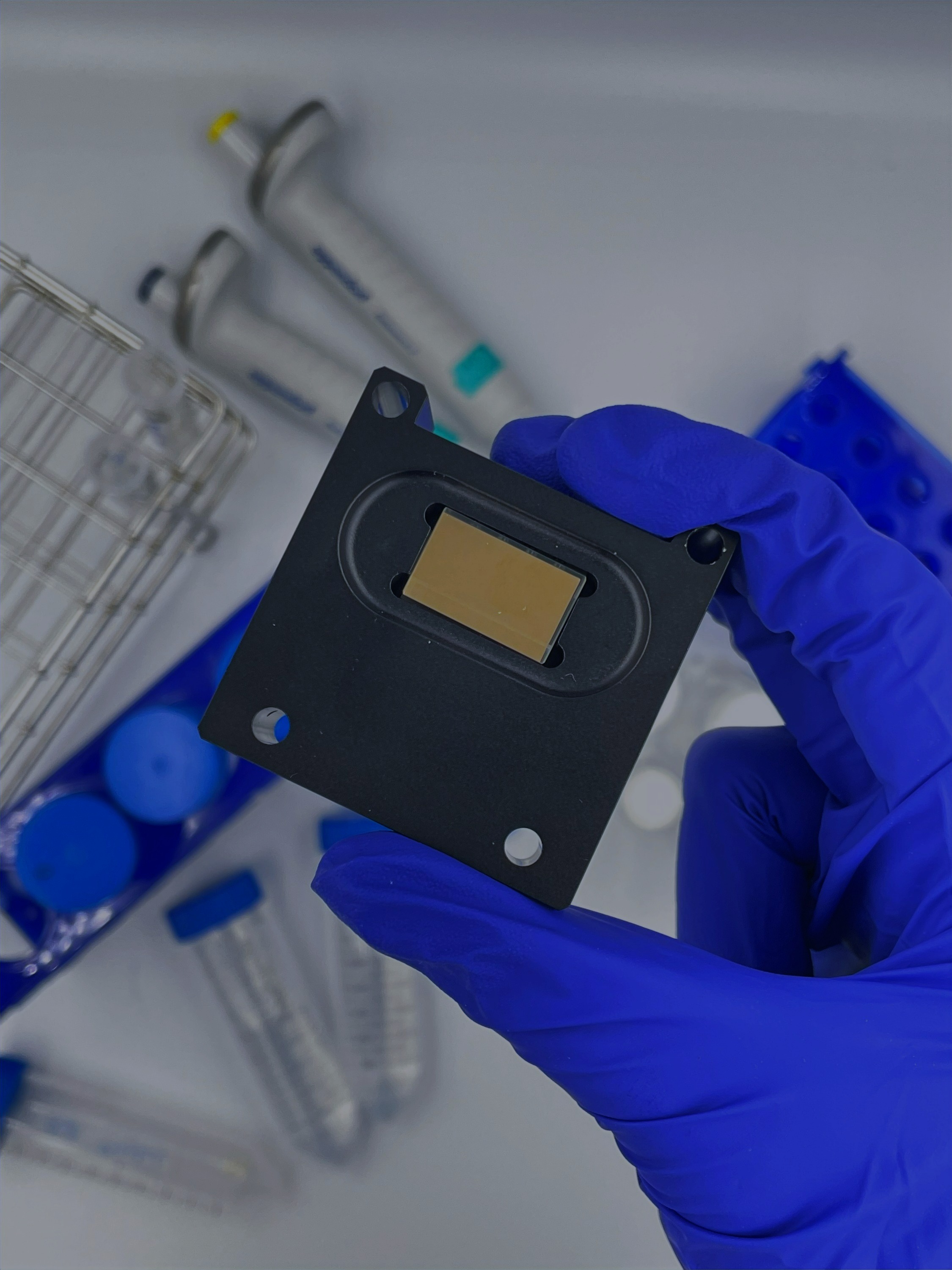
Afficoat, our proprietary surface chemistry, addresses one of the most persistent sources of noise in SPR experiments: non-specific binding. Rather than managing it at the data analysis stage, Afficoat controls it at the substrate level — engineering the gold sensor surface to resist non-target adsorption before the measurement begins. The consequence is cleaner sensorgrams, better reproducibility across users and runs, and a lower barrier for non-specialists to produce publication-quality binding data.
Our sensors are designed and validated in-house on Afficoat chemistry. The surface is not a commodity consumable — it is part of the measurement system. Researchers transitioning from our service engagements to in-house instrumentation continue on the same surface chemistry: no revalidation, no translation loss.
The algorithmic layer closes the loop. Sparq, our AI-powered run quality system, reads the sensorgram after every injection cycle, scores the data quality, identifies the pattern — ideal binding, bulk RI artifacts, baseline drift, poor regeneration, mass transport effects — and delivers a specific corrective action. This is not generic troubleshooting; it is pattern recognition trained on real SPR failure modes. The result is that the platform guides users toward better data actively, not just passively through good instrumentation.
One Architecture. One Platform Vision.
The combination — lensless detection, controlled surface chemistry, validated sensors, and algorithmic run quality — is what we mean by a translational biosensing platform. Each layer addresses a real barrier: the optical architecture addresses cost and portability, Afficoat addresses surface noise, the sensor design addresses reproducibility, and Sparq addresses the expertise gap in data interpretation.
Together, they are what makes it possible to move SPR binding data out of the core facility and into the lab, the field, and eventually the automated pipeline. That is the goal this architecture was built toward — not a smaller instrument, but SPR that works wherever the science happens.