
IN SHORT
- Static, no pump: shows whether it binds, how much, and how strongly (KD at equilibrium).
- Flow: also shows how fast it binds and lets go (kon, koff) (TN-10: From sensorgram to answer).
- Mass transport: when molecules arrive more slowly than the surface binds them, the curve shows delivery; lower the ligand density.
Overview
Binding can only happen when a molecule reaches the surface.
How the sample gets there, by diffusion alone or carried by flow, shapes the curve you record and decides which questions a run can answer.
1 · GETTING TO THE SURFACE
How molecules reach the surface
Close to the surface, molecules move by diffusion. As the surface captures them, the liquid just above it runs short of analyte: a depleted layer forms between the surface and the bulk of the sample.
Static. The sample sits over the surface. Diffusion alone refills the depleted layer, which grows thicker with time.
Flow. A steady stream carries fresh sample past the surface. The depleted layer stays thin, and its thickness is set by the flow rate and the channel geometry.

2 · MASS TRANSPORT
When delivery limits the curve
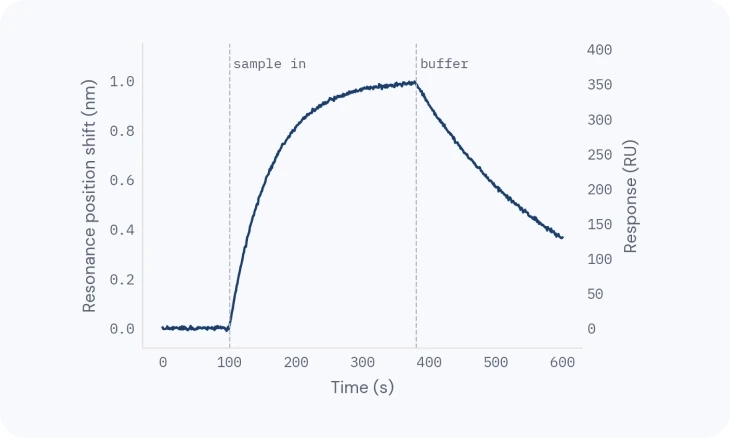
When molecules arrive more slowly than the surface could bind them, the curve reports delivery, not binding. This is mass-transport limitation. Its signs: an association that rises almost linearly instead of curving, a dissociation slowed down because released molecules rebind before they escape, and apparent rate constants that change with flow rate or ligand density.
It is strongest with fast binders, dense surfaces and large, slow-diffusing analytes. To reduce it, lower the ligand density (TN-06: The binding surface), raise the flow rate, and fit with a model that accounts for transport when needed (TN-10: From sensorgram to answer).

3 · STATIC MODE
Static mode: P4SPR 2.0
Samples are injected by syringe and left over the surface, with no pump and no fluidics.
Suited to: yes/no binding, affinity from equilibrium responses, concentration, screening, and method development in complex samples that should not pass through a flow path.
Strengths: small volume, four channels per injection, nothing to prime or clog, quick to set up, portable.
Limits: association is diffusion-driven and there is no continuous wash, so binding rates can’t be separated from delivery rates. Equilibrium is the goal, and it is reached given enough time (TN-10: From sensorgram to answer). Static, pump-free SPR is enough for equilibrium binding studies: a portable instrument characterized protein–heparin binding without a pump.
4 · FLOW MODE
Flow mode: P4PRO with AffiPump
The AffiPump drives a controlled stream, from 0.3 to 10,000 µL/min, through the flow cell, with injections of 5–100 µL. Add the autosampler to run 96-well plates.
Suited to: full kinetics (kon, koff, KD), repeated cycles and automated runs with an autosampler.
Strengths: a known, constant analyte concentration at the surface during association, and a clean buffer wash for dissociation.
Watch: load enough sample to cover the full injection, and degas buffers so no air reaches the flow cell.

5 · FOR BOTH
Practical points for both
Temperature. Let the chip, buffer and samples reach the same temperature before starting. Temperature shifts the refractive index and the baseline (TN-09: Getting a clean signal).
Degassing. Degas buffers. Air coming out of solution forms bubbles, which show up as sharp spikes or steps in a sensorgram.
Volume. In static mode, inject 200 µL of each sample, so it fully replaces the previous liquid over the sensing area.
6 · WHICH ONE?
Static or flow: which one?
Start from your question.
| Your question | Static (P4SPR 2.0) | Flow (P4PRO + AffiPump) |
|---|---|---|
| Does it bind? | ✓ | ✓ |
| How much is there (concentration)? | ✓ | ✓ |
| Affinity (KD) at equilibrium | ✓ | ✓ |
| Rate constants (kon, koff) | – | ✓ |
| Sample that shouldn’t go through a flow path | ✓ | – |
| Long automated runs | – | ✓ (with autosampler) |
Related
TECH NOTE · TN-07
Designing a binding experiment
Ligand or analyte, the concentration series, controls and replicates.
TECH NOTE · TN-09
Getting a clean signal
Referencing, buffer matching, drift and complex samples: how to keep only the binding.
TECH NOTE · TN-10
From sensorgram to answer
Reading the curve, then affinity, kinetics and active concentration you can trust.