
IN SHORT
- The plasmon: the dip appears when the light passes its energy to the electrons in the gold. A prism under the gold makes this possible.
- The detection zone: only what binds within a few hundred nanometres of the gold is seen: 200–300 nm for a film, tens of nanometres for a nanoparticle.
- Why a film: the light never goes through the sample, so serum and lysate work. That is why we use a gold film (TN-03: Lensless optics and wavelength readout).
Overview
The dip in the reflected light (TN-01: What SPR measures) appears when the light passes its energy to the electrons in the gold: a surface plasmon, a wave of electrons moving together along the metal, with a field that reaches a short distance into whatever touches it.
Exciting one with light is not as simple as shining a lamp on gold. This note explains why, the ways it is done, and why we use a continuous gold film rather than nanoparticles: what each one sees, and where the light goes.
1 · WHY LIGHT NEEDS HELP
Light needs a coupler
Light hitting flat gold from air or water cannot excite a surface plasmon directly: at any given colour, the plasmon carries more momentum along the surface than the light can supply. Something has to make up the difference: a coupler.
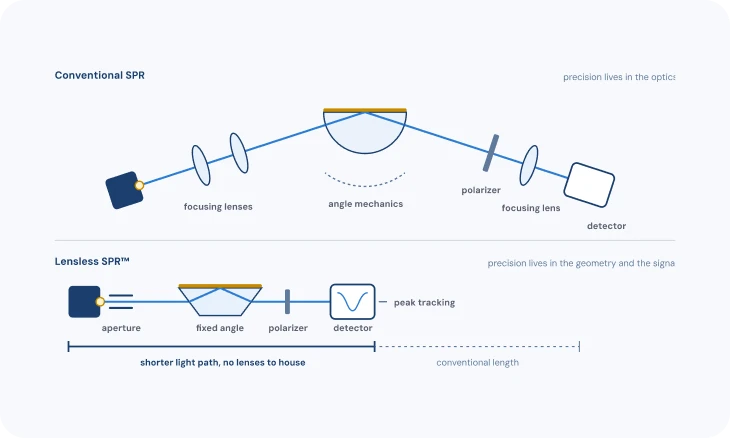
The prism geometry with a roughly 50 nm gold film, the Kretschmann configuration, is the most used and most robust for biosensing. Light stays in the glass and never passes through the sample, which is why turbid or coloured samples can be measured (TN-03: Lensless optics and wavelength readout).

2 · TRAVELLING AND LOCALIZED
Two kinds of plasmon
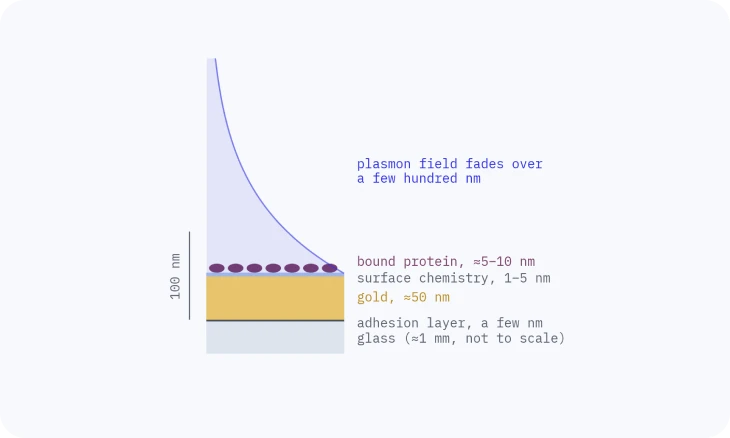
A continuous film carries a propagating plasmon: it travels along the surface for micrometres, and its field reaches about 200–300 nm into the liquid. A nanoparticle carries a localized plasmon: confined to the particle, its field reaches only tens of nanometres.
That difference decides what each sensor sees. An antibody (about 10 nm) fits inside both fields. A virus or vesicle (about 100 nm) is fully inside the film's field, but mostly outside a nanoparticle's. A short field responds less to bulk changes from the buffer, but its working range is small and particle-to-particle differences add variability.

3 · SENSITIVITY
How far the resonance moves
Bulk sensitivity is how far the resonance shifts for a change in refractive index (nm per refractive-index unit, RIU). A gold film in the Kretschmann geometry gives about 1800 nm/RIU near water; gold nanoparticles typically give a few hundred. Sensitivity is not constant: as the refractive index rises, the resonance moves to longer wavelengths, where it shifts more per unit of refractive index. Small binding signals stay effectively linear, but over bulk changes of about 0.01 RIU or more the response curves upward.
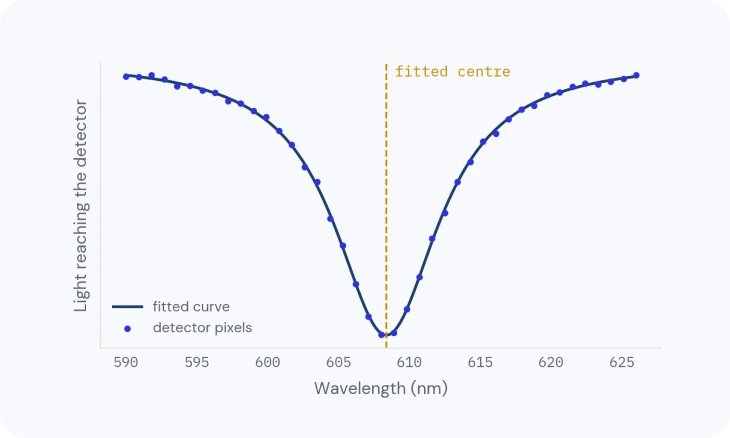
The same small buffer change of 0.001 RIU moves a gold-film resonance by about 1.8 nm, and a typical nanoparticle resonance by a few tenths of a nanometre. High bulk sensitivity is not the whole story: what matters is how much of the binding happens inside the field, and how precisely the resonance is tracked (TN-04: Where the precision comes from).
| Parameter | Thin-film SPR | Nanoparticle LSPR |
|---|---|---|
| Detection depth | About 200–300 nm: room for large targets, cells and sandwich assays. | Tens of nanometres: very surface-local, with a small working range. |
| Sensed area | The whole spot: many binding events averaged in one reading. | Each particle alone: few binding events per reading. |
| Surface chemistry | Thick or layered coatings fit inside the field. | Thin coatings only: a thick layer fills most of the field. |
| Light path | Light reflects under the gold and never crosses the sample. Turbid, coloured or opaque samples can be measured directly. | Usually read in transmission: light crosses the sample, so clear samples work best. |
| Sensitivity (nm/RIU) | About 1800 near water, rising at longer wavelength | A few hundred |
| Sensor format | A continuous film on glass: reproducible to make and easy to functionalize. | Particles in suspension or fixed on glass: more steps, and more variation between particles. |
| Diffusion mode | Planar: matches most of the SPR kinetics literature. | Radial, around each particle: a different mass-transport profile. |
4 · USING BOTH
Nanoparticles on a film
The two kinds of plasmon can work together. Gold nanoparticles grown on top of a gold film, or attached as labels, couple electromagnetically to the film's plasmon and add a large response. This can amplify a small-molecule signal: the drug doxycycline was detected this way on a P4SPR (TN-07: Designing a binding experiment).
Related
TECH NOTE · TN-03
Lensless optics and wavelength readout
Angle vs wavelength readout, what a conventional optical bench needs, and what the lensless design changed.
TECH NOTE · TN-04
Where the precision comes from
How the dip is located more finely than one pixel, and what sets the smallest shift you can see.
TECH NOTE · TN-05
The chip
What makes a good gold film, how films are made, and what degrades them.