
IN SHORT
- Wavelength readout: we read the dip by its colour (wavelength) at one fixed angle.
- No lenses: no long light path and nothing to align or drift, so the instrument is simpler, sturdier and compact (P4SPR 2.0: 25 × 25 × 6 cm).
- Four channels, one spectrometer: all four channels are read in turn by the same spectrometer, about a quarter-second apart, and precision comes from the software (TN-04: Where the precision comes from).
Overview
Most SPR instruments shine polarized light through a prism onto a thin gold film (the Kretschmann configuration) and watch for the resonance (TN-02: Why a gold film). Instruments differ in how they find that point, and that choice decides almost everything about the optics around it.
This note compares the two ways of reading a resonance, what a conventional optical train needs, what we changed in the lensless design, what that costs, and what it makes possible.
1 · TWO WAYS TO READ IT
Angle readout and wavelength readout
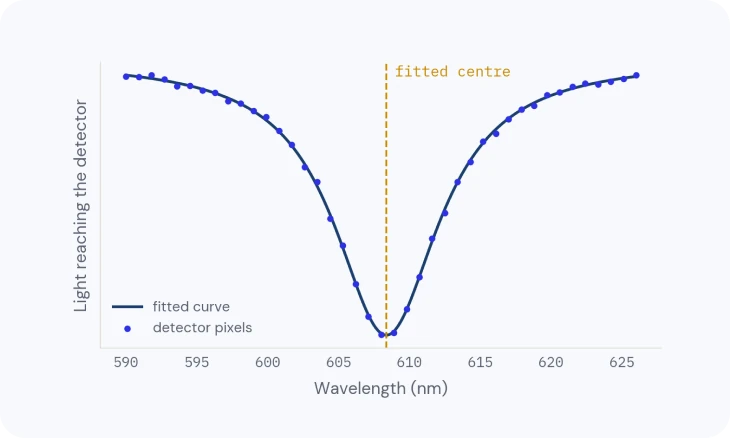
The resonance depends on both the angle of the light and its wavelength. Fix one and scan the other, and you get a dip in the reflected light. Angle readout fixes the wavelength and scans the angle, with a moving stage or a converging fan of angles spread over a detector array. Wavelength readout fixes the angle and reads the whole spectrum with a broadband source and a spectrometer.
Both are established and both work. Wavelength readout is what makes it possible to remove most of the optics: once the angle is fixed, nothing has to move or be focused.

2 · THE CONVENTIONAL TRAIN
What a conventional optical bench needs, and why
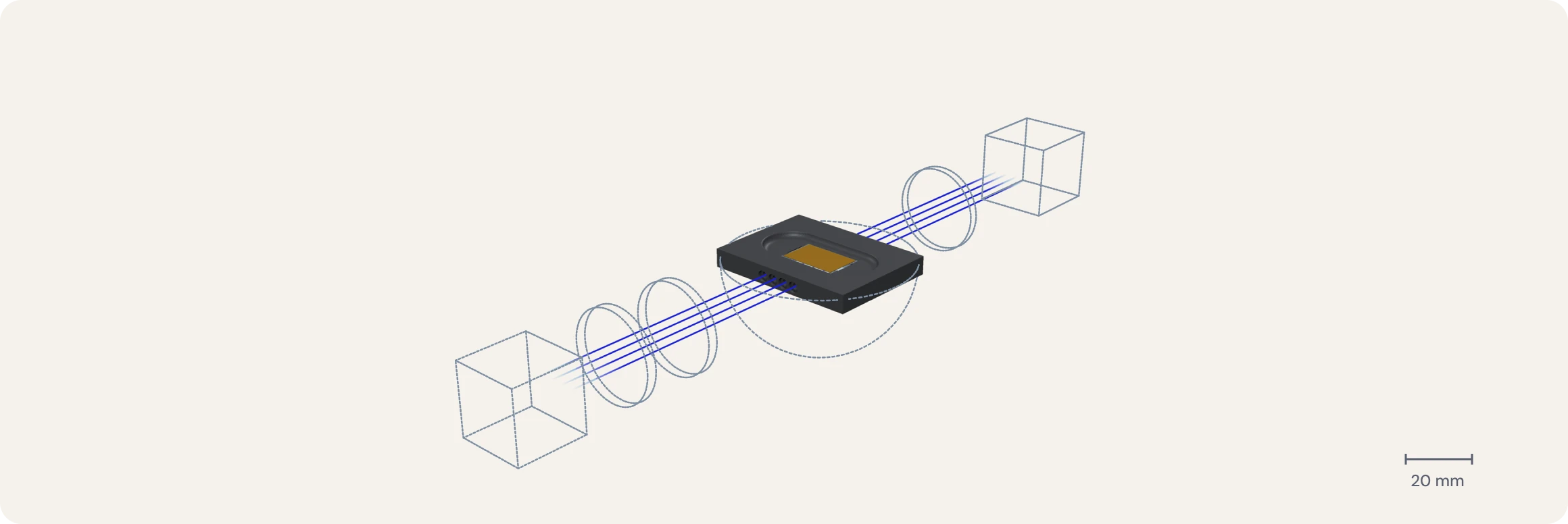
A classic Kretschmann instrument with angle readout typically includes collimating and focusing lenses to shape the beam and focus a range of angles on the gold; a polarizer, because only p-polarized light excites the plasmon; an angle mechanism; a hemispherical prism with the source and detector on angled arms; a lens in front of the detector; and, for several channels, a copy of the optics or an imaging camera.
Each element is there for a reason, and together they give very high resolution. But each one has to be held in alignment, and the whole system is sensitive to vibration, temperature and handling. That is a large part of why SPR has lived in central labs, run by specialists.
3 · THE LENSLESS PATH
One straight line, machined in
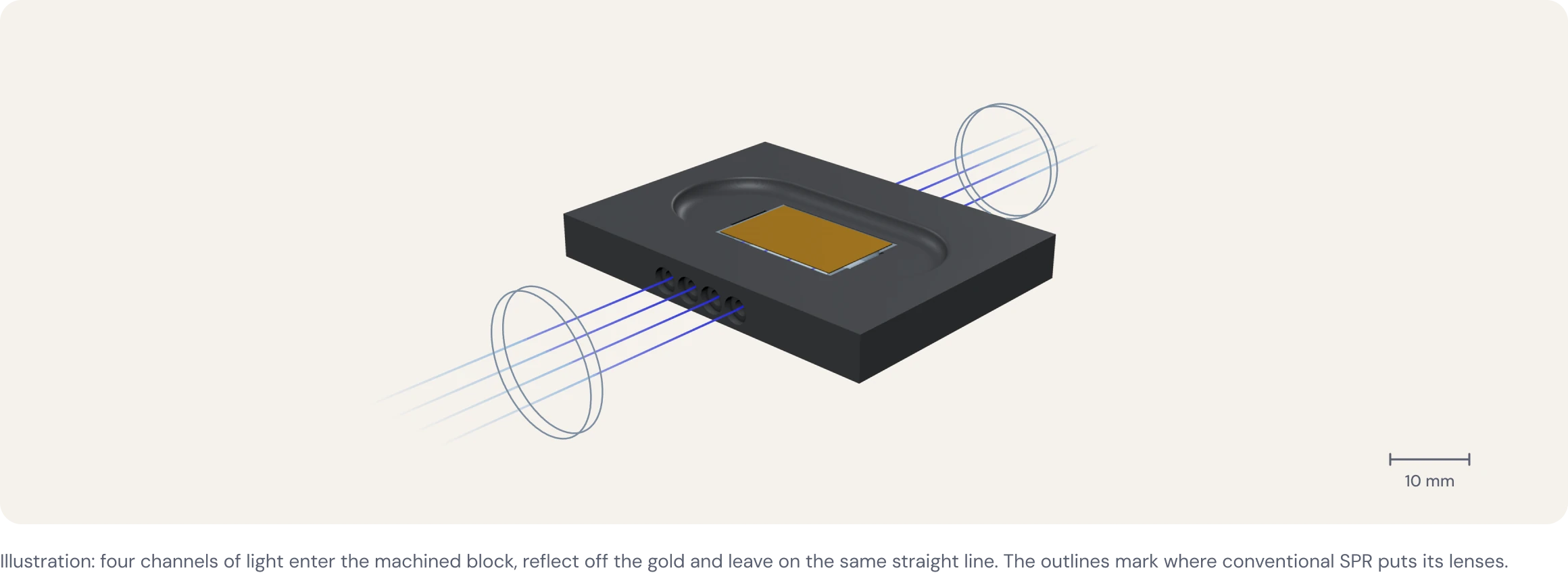
The lensless design starts from the same Kretschmann geometry and the same physics, keeps what the measurement needs, and replaces the rest with fixed, machined geometry. One broadband LED per channel; a machined aperture shapes the light and sets the angle; a Dove prism carries the gold, so light enters through one face, reflects once under the gold and leaves parallel to the way it came in; a polarizer; and optical fibres carrying each channel to one shared spectrometer. The LEDs fire in turn, so four channels share one spectrometer without overlapping.
The optical module fits within the footprint of an earbud case. With the detector, the whole measurement is about the size of a pipette-tip box, and a complete P4SPR 2.0 measures 25 × 25 × 6 cm.
| Conventional component | Lensless replacement | What changes for you |
|---|---|---|
| Collimating and focusing lenses | Aperture tunnels machined into the block | Nothing to align or drift out of focus |
| Rotating stage or angle-spread optics | Fixed angle, wavelength readout | No moving parts |
| Hemispherical prism with arms for source and detector | Dove prism, straight-line path | A short path in a small block |
| Polarizer | Polarizer (kept) | Same physics as any SPR |
| A detector or optical train per channel | One LED per channel, fibres to one spectrometer | Every channel is a copy of the first |
4 · WHAT IT TOOK
Removing the lenses meant redesigning everything around them
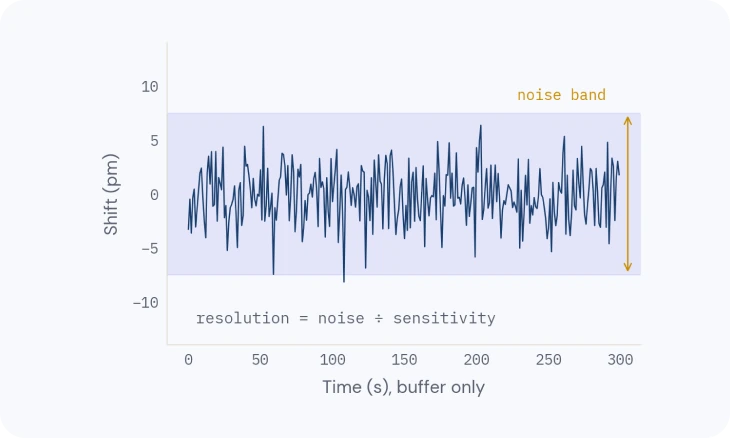
Taking the lenses out has a cost: fewer optical components means a less refined raw signal than a precision optical bench. A lensless instrument only works because that cost is paid back somewhere else, in four places, each cheaper and more flexible than more glass. Together they replace what the lenses did, and each can keep improving without touching the hardware.
Proprietary data processing
Peak tracking, built-in referencing and per-channel quality checks: much of the precision conventional instruments get from optics, we recover in software (TN-04: Where the precision comes from).
Ready-to-use surface chemistries
Sensors arrive functionalized, with matched kits and guided methods, so you start at the capture step, not at the gold (TN-06: The binding surface).
Shelf-stable, robust materials
A consistent chip, surfaces made to be stored and shipped, and low-fouling coatings that resist real samples (TN-05: The chip).
Assay strategies
Built for the larger shifts of proteins and particles in real samples, with signal-creating formats for small molecules and a reference in every run (TN-07: Designing a binding experiment).
5 · WHAT IT MAKES POSSIBLE
Small, identical, and nothing to realign
Every channel is a copy of the first, so one reference and three samples are measured through identical optics. Moving the instrument, opening a hood or changing benches does not disturb the optics. A full instrument travels in a carry-on and runs on arrival; an earlier generation measured explosive residue in environmental water on site.
When the light path is a machined part, the instrument stops being the difficult piece. What decides your data quality becomes the surface chemistry (TN-06: The binding surface) and the assay design (TN-07: Designing a binding experiment).

Related
TECH NOTE · TN-04
Where the precision comes from
How the dip is located more finely than one pixel, and what sets the smallest shift you can see.
TECH NOTE · TN-05
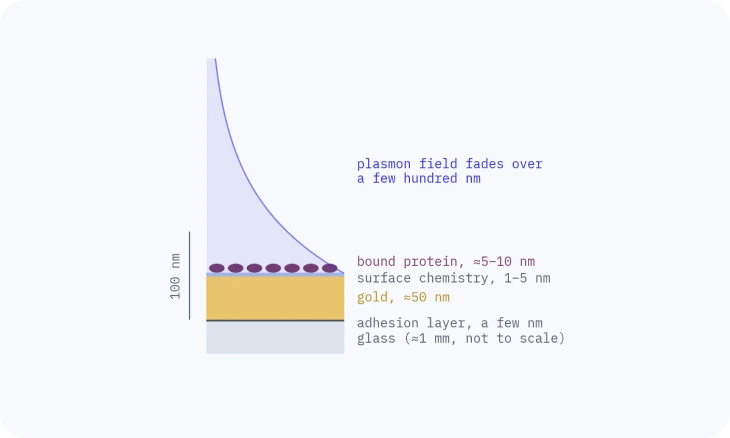
The chip
What makes a good gold film, how films are made, and what degrades them.
TECH NOTE · TN-09
Getting a clean signal
Referencing, buffer matching, drift and complex samples: how to keep only the binding.